Temple of Augustus
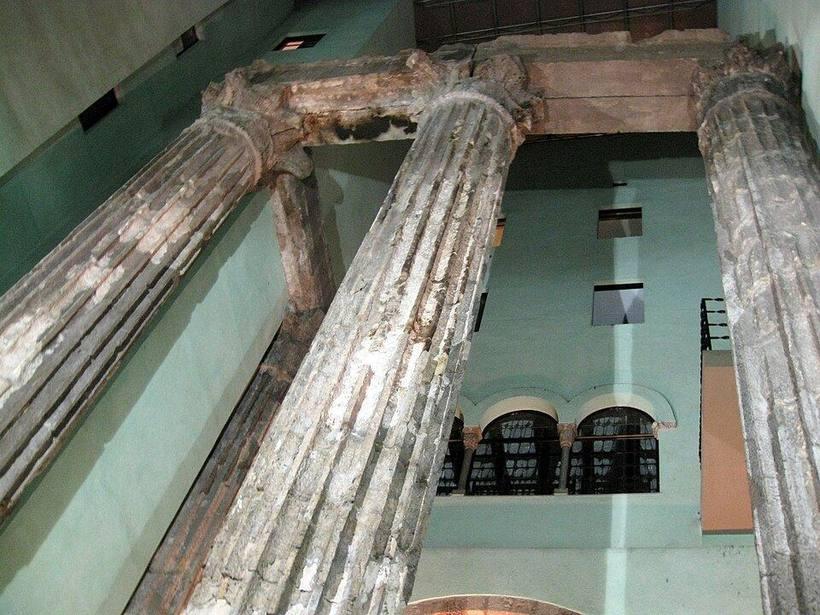
Four columns of the imperial temple, hidden in a courtyard on Carrer del Paradís.

A Roman town of 12.5 hectares became a metropolis of 1.7 million people. Here is how, in nine chapters, with a map of the eras and the myths untangled.
Full read: about 25 minutes.
200 av. J.-C. · Iberian Laietania No town yet: Laietani villages on Montjuïc and across the plain.
15 av. J.-C. · Barcino A Roman colony of 12.5 ha on Mont Táber.
350 · The wall of 78 towers In the 4th century, Barcino barricades itself.
1260 · Walls of James I The city spills out as far as the Rambla stream.
1370 · The Raval walled in Peter III encloses convents, hospitals and orchards.
1716 · La Ciutadella After 1714, a fortress razes part of La Ribera.
1753 · La Barceloneta A fishermen’s quarter on a sandbank.
1860 · Cerdà Plan The walls come down; the grid stretches towards the mountain.
1888 · Universal Exhibition The citadel becomes the Parc de la Ciutadella.
1897 · The great annexation Gràcia, Sants, Sant Andreu… villages become districts.
1929 · Montjuïc Exhibition Palaces, the Magic Fountain and the Mies van der Rohe pavilion.
1992 · Olympic Games The city turns to face the sea: beaches and Vila Olímpica.
2026 · Today Fòrum, Torre Glòries and the Sagrada Família at 172.5 m.
Schematic plan, sea at the bottom and mountain at the top, the way Barcelonans find their bearings (“mar” / “muntanya”). North points to the upper left. Approximate scale.
Landmarks · the timeline to scale
≈ 600 – 15 BC
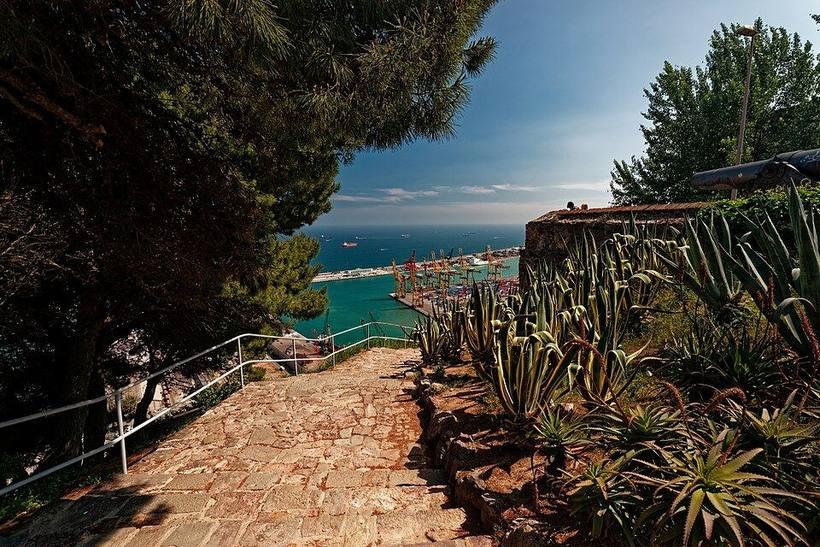
Before it was a city, Barcelona was a landscape: a plain wedged between two rivers, the Llobregat and the Besòs. It backs onto the Serra de Collserola. On the sea side, an isolated hill stands guard: Montjuïc. The Iberian Laietani lived here in fortified villages. On Montjuïc, archaeologists have found a settlement and grain silos. Coins of the period bear the name Laieśken.
Guides will tell you that Hercules, or the Carthaginian Hamilcar Barca, founded the city, hence “Barca-nona”. It is a fine story, forged by Renaissance scholars who wanted a prestigious origin. No excavation supports it. The name most probably comes from an Iberian place name, Barkeno, struck on coins.
The name Montjuïc is disputed. “Mount of the Jews”, since a medieval Jewish cemetery was excavated there, or “Mount of Jupiter” (Mons Iovis)? Both camps have their arguments.
15 BC – 415
A few years before the Common Era, under Augustus, Rome founded a colony on Mont Táber. This is a 16-metre mound at the heart of today’s Gothic Quarter. Its full name is a political programme: Colonia Iulia Augusta Faventia Paterna Barcino. It covered about 12.5 hectares, roughly seventeen football pitches.
The plan is classical: two main axes, the cardo and the decumanus, cross at the forum. Today the Plaça Sant Jaume lies there, seat of the city hall and the Catalan government. Power has not moved in two thousand years. In the 4th century, under threat, the town built a wall over 1,200 metres long, bristling with 78 towers. Fine stretches of it survive.
In 415, the Visigothic king Ataulf settled in Barcino with his wife Galla Placidia, the emperor’s sister. He was murdered there the same year. For a few months, Barcelona was the capital of a kingdom.
Four Corinthian columns from the Temple of Augustus, about 9 metres high, hide in the courtyard of a building on Carrer del Paradís. Entry is free, and almost nobody goes.
415 – 988
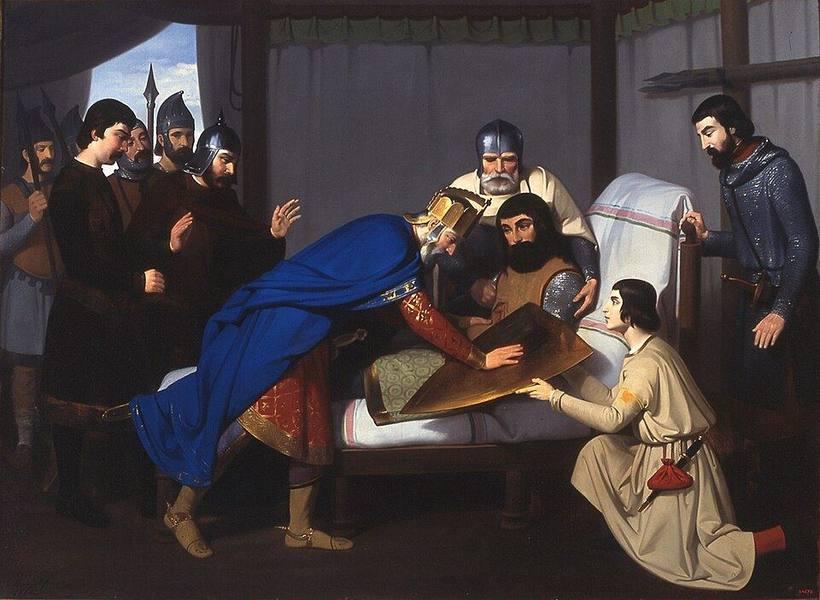
After Rome, the city changed hands repeatedly. The Visigoths held church councils here. In 717-718, Muslim troops took it with little resistance. In 801, Louis the Pious, son of Charlemagne, retook it after a siege. Barcelona became the southern tip of the Hispanic March, a buffer zone of the Carolingian empire.
The counts appointed by the Franks soon made themselves at home. Guifré el Pilós (Wilfred the Hairy), count from 878 to 897, made his title hereditary. Catalans regard him as the founder of the dynasty. Legend has the emperor tracing the four red bars of the senyera with fingers dipped in the wounded count’s blood. It was invented in the 16th century.
In 985, the Andalusi leader Al-Mansur razed the city. Count Borrell II called on the Franks for help; nobody came. In 988, he refused to pay homage to the new king, Hugh Capet. Catalans date their de facto independence from this refusal.
The “legend of the four bars” first appears in 1551, in a chronicle by the Valencian historian Pere Antoni Beuter. That is more than six centuries after Guifré’s death.
1137 – 1410
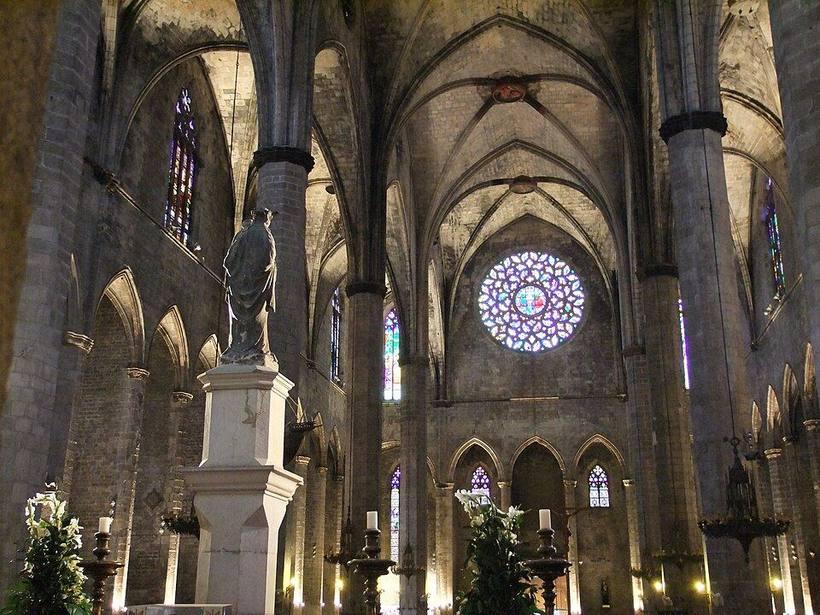
In 1137, Count Ramon Berenguer IV was betrothed to Petronilla, heiress of Aragon. The Crown of Aragon was born, a confederation with Barcelona as its economic engine. James I the Conqueror (1213-1276) took Majorca and Valencia. He gave the city the Consell de Cent, a council of a hundred burghers and craftsmen that would govern it for over four centuries.
The city outgrew its Roman walls. A new circuit was built along a dry riverbed, the future Rambla, then a third enclosing the Raval. Merchants paid for Santa Maria del Mar, built in just 54 years (1329-1383). Tradition says the bastaixos, the port’s porters, carried its stones down from Montjuïc on their backs. The Drassanes, the royal shipyards, built the Crown’s galleys.
Barcelona drew up the Llibre del Consolat de Mar, a code of maritime law used throughout the Mediterranean. It created the Generalitat in 1359 and, in 1401, the Taula de Canvi, one of Europe’s first public banks. Yet the plague of 1348 wiped out a large share of the population. In 1410, Martin the Humane died without an heir, ending the dynasty of the Counts of Barcelona.
La Rambla takes its name from the Arabic ramla, “sandy bed”. It was a stream that served as a sewer and as a ditch below the 13th-century wall. It was only paved in the 18th century.
1410 – 1714
The new Castilian dynasty, the Trastámaras, arrived in 1412. The marriage of Ferdinand of Aragon and Isabella of Castile (1469) bound Catalonia to a new whole. Its centre of gravity shifted towards Madrid and the Atlantic. Yet in April 1493, the Catholic Monarchs received Christopher Columbus in Barcelona, back from his first voyage. Tradition places the scene in the Saló del Tinell.
On 7 June 1640, harvesters in revolt against the soldiers of Philip IV killed the viceroy. This was the Corpus de Sang, start of the Reapers’ War. Catalonia placed itself under the protection of Louis XIII, then Barcelona surrendered in 1652. Under the Treaty of the Pyrenees (1659), Roussillon became French.
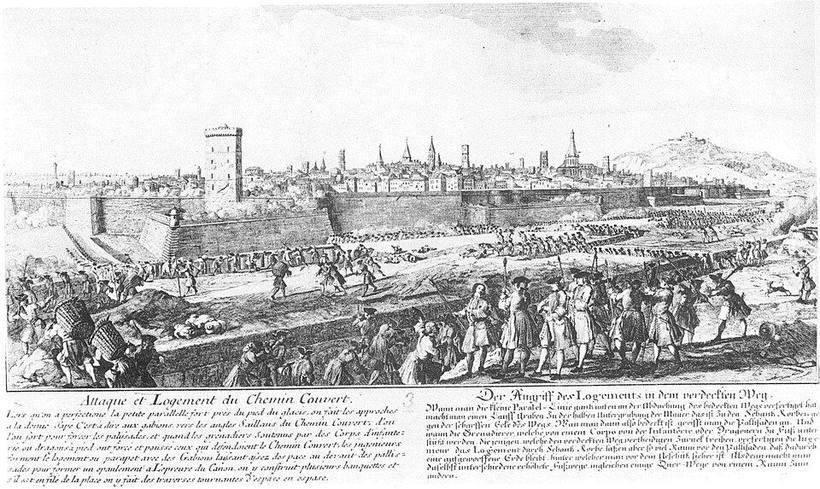
During the War of the Spanish Succession, Barcelona backed Archduke Charles of Austria against Philip V of Bourbon. It withstood a fourteen-month siege. On 11 September 1714, the city fell. The Nueva Planta decrees abolished the Catalan institutions. To keep watch on the city, the king had over a thousand houses in La Ribera razed and a citadel built. 11 September has become Catalonia’s national day, the Diada.
The residents evicted from La Ribera waited nearly forty years to be rehoused. It came in 1753 with the Barceloneta, a quarter of small low houses laid out in straight lines by a military engineer on a sandbank.
1714 – 1888
In the 18th century, Barcelona recovered through textiles. The “indianes”, printed cotton cloths, made its fortune. In 1778, the opening of trade with the Americas enriched the “indianos” returning from Cuba. In 1832, the Bonaplata mill installed Spain’s first industrial steam engine. In 1848 the first railway line on the peninsula opened, to Mataró.
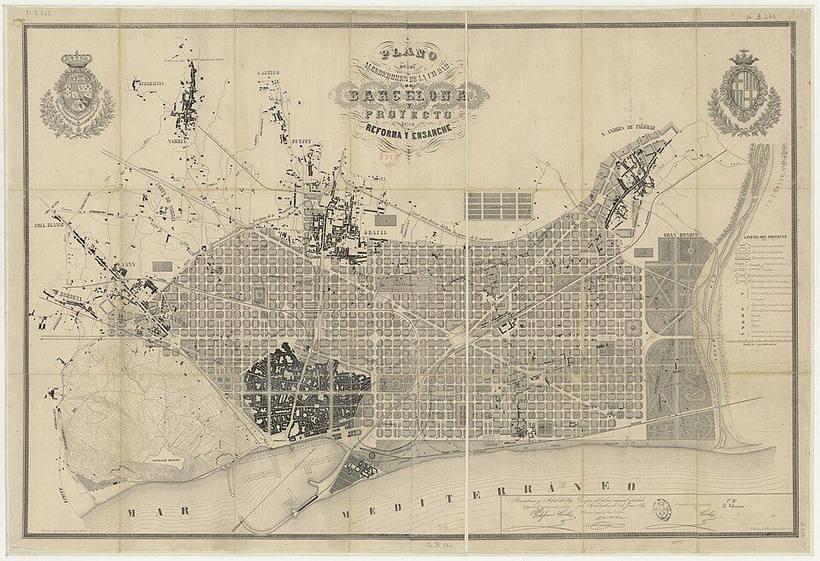
The problem: everyone lived crammed inside ramparts the army forbade them to cross. Cholera epidemics, wretched life expectancy. In 1854, the city finally won the right to tear down its walls. The plan by the engineer Ildefons Cerdà was approved in 1859. It is a grid of square blocks of about 113 metres, with 20-metre streets and corners cut at 45°. At first, only two sides were to be built, to let in sun and air.
Landowners loathed this plan imposed from Madrid; little by little they filled in all four sides and the block interiors. In 1888, the Universal Exhibition turned the hated citadel into the Parc de la Ciutadella. Its entrance is a brick Arc de Triomf.
Cerdà coined the word “urbanisation” (urbanización) in his General Theory of Urbanisation of 1867. The cut corners were meant to let future steam trams turn.
1888 – 1931
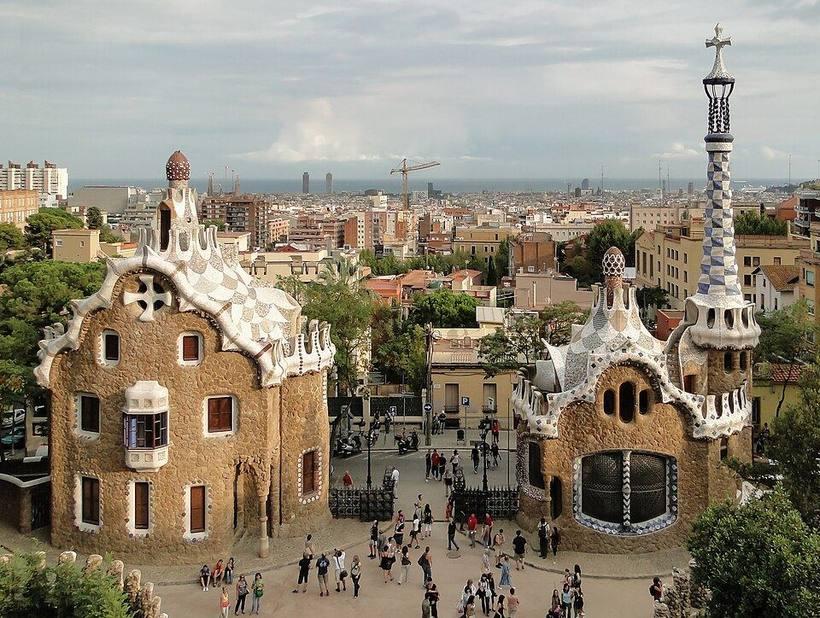
The newly rich bourgeoisie wanted an architecture that said “Catalonia”. It found one in Modernisme. Antoni Gaudí took over the Sagrada Família in 1883, then designed Casa Batlló and La Pedrera on Passeig de Gràcia. Lluís Domènech i Montaner gave the city the Palau de la Música and the Hospital de Sant Pau; Josep Puig i Cadafalch, Casa Amatller. The flower tile still underfoot on the pavements is also attributed to him.
In 1897, the city annexed its neighbours: Gràcia, Sants, Sant Andreu, Sant Martí, Les Corts, Sant Gervasi. The industrial working class grew, and anarchism with it. A bomb at the Liceu in 1893, the Tragic Week of 1909 with its burnt convents: the city earned the nickname “la Rosa de Foc”. In 1919, the La Canadenca strike won the eight-hour day for all of Spain.
Gaudí, knocked down by a tram on 7 June 1926, died three days later. He had been taken for a beggar. In 1929, a second International Exhibition covered Montjuïc with palaces, a magic fountain and a German pavilion by Mies van der Rohe.
In 1924, Gaudí spent a few hours at a police station for refusing to speak Castilian to an officer. It happened at a commemoration of 11 September, banned by the Primo de Rivera dictatorship.
1931 – 1975
On 14 April 1931, Francesc Macià proclaimed the Catalan Republic from the balcony on Plaça Sant Jaume. Three days later, it became an autonomous Generalitat. On 19 July 1936, workers and assault guards crushed the military uprising in the streets. Barcelona became the capital of an anarchist revolution, described by George Orwell in Homage to Catalonia.
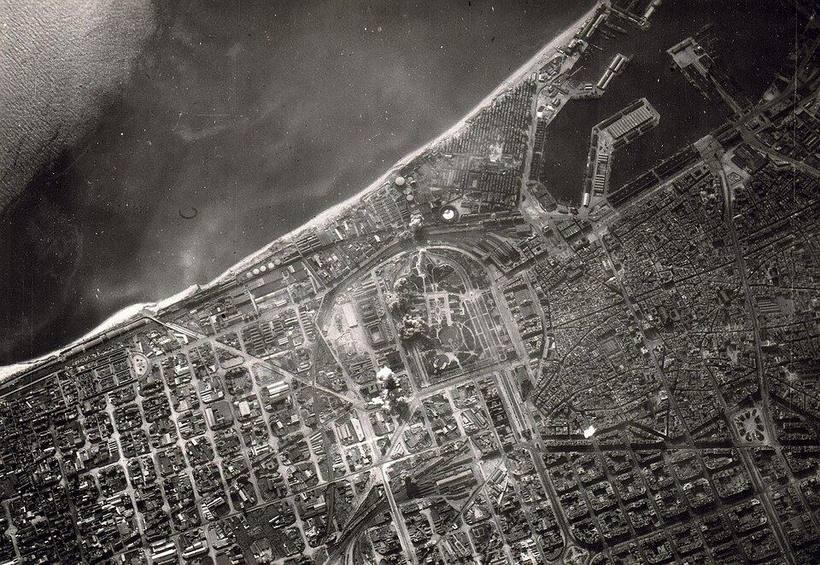
In March 1938, Italian aircraft serving Franco bombed the city for three days; nearly a thousand died. Shrapnel from the bomb that fell on Plaça de Sant Felip Neri in January 1938 still scars the church walls. On 26 January 1939, Franco’s troops entered the city.
President Lluís Companys, handed over from France by the Gestapo, was shot at Montjuïc Castle on 15 October 1940. Decades of repression of Catalan followed. From the 1950s, hundreds of thousands of migrants arrived from Andalusia, Murcia and Galicia. They were housed in shacks on Montjuïc and Somorrostro beach, then in large estates. The Camp Nou, opened in 1957, became, so it is said, one of the few places where people could shout in Catalan.
On 1 March 1951, Barcelonans boycotted the trams in protest at a fare rise. It was the first large-scale protest under Franco, and it won: the rise was cancelled.
1975 – 2026
Franco died on 20 November 1975. On 23 October 1977, Josep Tarradellas, president of the Generalitat in exile, returned to Barcelona. From the balcony, he declared: “Ciutadans de Catalunya, ja sóc aquí!” The Socialist mayors Narcís Serra and then Pasqual Maragall staked everything on public space. Squares, parks, sculptures and the renewal of the old town followed.
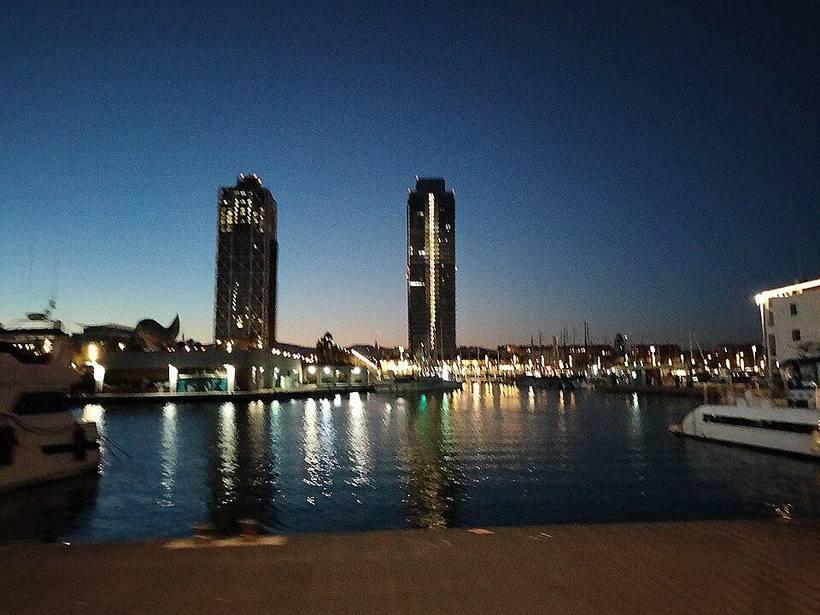
On 17 October 1986, Juan Antonio Samaranch announced that Barcelona would host the 1992 Games. The city used them to turn towards the sea: railways buried, the Vila Olímpica, ring roads, beaches created or restored. The “Barcelona model” set an example, but it also drew tourists by the million. Rents, tourist flats, cruise ships: in 2024 the city announced plans to abolish its 10,000 or so tourist-rental licences by 2028.
The city has also known its tragedies and divisions. The Rambla attack struck on 17 August 2017; the self-determination referendum was held on 1 October that year. In 2026, Barcelona is UNESCO-UIA World Capital of Architecture. On 20 February, the cross was set atop the Tower of Jesus Christ, at 172.5 metres. The Sagrada Família became the tallest church in the world. On 10 June, centenary of Gaudí’s death, Pope Leo XIV came to bless it.
Before 1992, the Barceloneta and Poblenou had almost no usable beach. Much of today’s sand was brought in and must be topped up regularly after storms.
Orders of magnitude. Before the 19th century, historians work from estimates (tax hearths, partial censuses); margins of error often exceed 20 %. The fall after 1979 reflects families leaving for the metropolitan periphery, not a decline of the region.
| 1st c. | 1 500 |
| ≈1340 | 40 000 |
| 1717 | 37 000 |
| 1787 | 95 000 |
| 1860 | 190 000 |
| 1900 | 533 000 |
| 1930 | 1 006 000 |
| 1950 | 1 280 000 |
| 1979: peak | 1 907 000 |
| 2001 | 1 505 000 |
| 2025 | 1 700 000 |
Barcelona loves its legends. Eight claims heard in the streets and from guides. You decide.
Four columns of the imperial temple, hidden in a courtyard on Carrer del Paradís.
Laietani Iberian settlement and grain silos on the hill.
Catalan Gothic; the neo-Gothic façade was only completed in 1913.
The “cathedral of the sea”, paid for by merchants and built by porters.
A fortress built after 1714 to hold the city in check.
Rows of low houses for those evicted from La Ribera.
The opera house of the bourgeoisie, struck by an anarchist bomb in 1893.
172.5 m since 2026: the tallest church in the world.
The “house of bones”, remodelled by Gaudí on Passeig de Gràcia.
Casa Milà: an undulating stone façade that bears no load; everything rests on pillars.
In this guide : La Pedrera, the house without load-bearing walls →
A failed garden city turned public park.
Domènech i Montaner: stained-glass skylight, mosaics and sculpture.
In this guide : Palau de la Música Catalana, the glass hall →
A Modernista hospital-city of pavilions linked by tunnels.
The Exhibition palace, now the National Art Museum of Catalonia (MNAC).
Dismantled in 1930, rebuilt identically in 1986.
Prison and place of execution; Companys was shot here in 1940.
Barça’s stadium, renovated for the 21st century.
A 1929 stadium renovated for the Games.
A former industrial district turned athletes’ village.
Jean Nouvel’s 144 m tower, shaped like a geyser.