
History and heritage · Place · checked on 05/11/2026
El Barri Gòtic · Barcelona

Barcelona Cathedral, Gothic twice over

The Cathedral of the Holy Cross and Saint Eulalia is the heart of the Barri Gòtic. Its interior is Gothic, begun in 1298. Its famous façade is Gothic too, but it dates from 1913. A visit means learning to tell the two apart.

  • 12stops
  • 2 hrto visit

This guide follows the cultural visit: the nave, then the six spaces on the ticket, and two detours outside as you leave.

Monday–Friday

Mass at 9:00 and 19:15, in the Chapel of the Blessed Sacrament, according to Barcelona Urbana. · 9:30–18:30 · 17:45

The longest window. Arrive at opening time: groups turn up around 11:00. Allow 2 hours for the six spaces on the ticket.

Saturdays and eves of holidays

Mass times to be checked on the cathedral’s website. · 9:30–17:15 · 16:30

Earlier closing: start before midday if you want the rooftops and the museum without rushing.

Sundays and religious holidays

Mass at 9:00, 10:30, 12:00, 13:00, 18:00 and 19:15, according to Barcelona Urbana. · 14:00–17:00 · 16:30

Only three hours, in the afternoon. In the morning the nave is open for Mass, with no visits. It is the time to see the church in use, not to tour it.

Status as of 05/11/2026

The ticket has gone up to €16. The official website shows €16 full price and €14 reduced. The City of Barcelona’s listings still give €14 and free entry from 9:30 to 18:30. That municipal page is out of date: rely on the official price.

In late November the Fira de Santa Llúcia sets up in front of the façade, until Christmas. The 2026 dates had not been published on 5 November. The square will be more crowded, and the façade less clear for photographs.

Gothic building work begins on 1 May, under Jaume II.
1298
Completion of the neo-Gothic façade and spire.
1913
Chapter of the Golden Fleece convened in the choir by Charles V.
1519
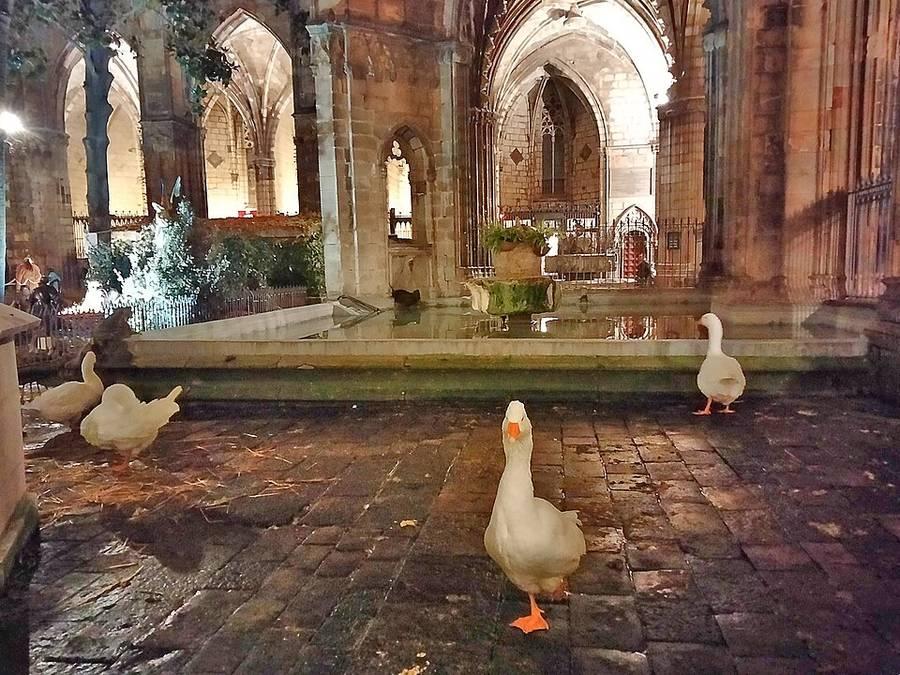
White geese in the cloister, one for each year of Eulalia’s life, according to tradition.
13

The approach

Two Gothics in a single building.

The interior, the cloister and the bell towers date from 1298 to the 15th century. The façade and spire date from 1887–1913. The postcard monument is therefore, in its most visible part, a work of the late 19th century. It is contemporary with Modernisme.

A cathedral on three cathedrals.

A Christian church is recorded as early as 394, a basilica is attested in the 6th century, and a Romanesque cathedral was consecrated in 1058. The Gothic building replaced them on the same site. The early Christian remains can be visited at the MUHBA, Plaça del Rei.

Eulalia’s cathedral.

Dedicated to the Holy Cross and Saint Eulalia, the cathedral is the centre of the cult of the city’s co-patron saint. The crypt, the geese and the February festival all bear witness to it. It is not Barcelona’s largest church, but it is the archbishop’s seat and the religious heart of the old city.

A place of worship that charges for visits.

The €16 ticket covers the cultural visit. During Mass, entry is free to attend the service, not to sightsee. This separation, as at the Sagrada Família or Santa Maria del Mar, is the rule in the city’s great churches.

The route

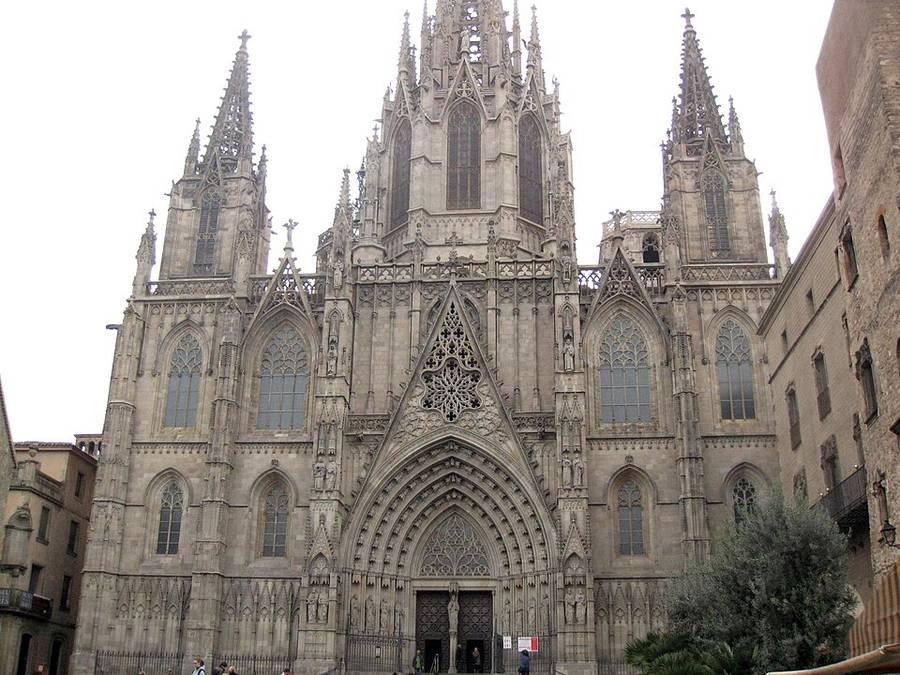
Neo-Gothic façade of Barcelona Cathedral seen from the square
The neo-Gothic façade, on the Pla de la Seu.Photo: Enfo · CC BY-SA 3.0 · Wikimedia Commons
01
Must-seeOutsideFree

The façade, from the Pla de la Seu

Where
Pla de la Seu, 3
Time on site
10 min

Step back to the middle of the square before going in. This façade looks like the oldest part of the monument: it is the newest. For nearly four centuries the main entrance remained a bare, unfinished wall.

It was built from 1887 to 1913 by the architect Josep Oriol Mestres, after a 1408 design by Master Carlí, a Frenchman. The banker Manuel Girona, then his heirs, paid for the façade and the central spire. The Gothic you see is late 19th-century Gothic imitating the 15th century.

What to look for

  • The central spire (the cimbori), completed in 1913.
  • The difference in stone and crispness between the façade and the older side walls.
  • The remains of the Roman wall to the left of the square, and the PICASSO frieze on the Col·legi d’Arquitectes opposite.

The guide’s view

Come back to the square at dusk: the façade is lit and the crowds have gone. The sardana circles sometimes danced here have no published schedule: check the city’s listings.
OpenStreetMapGoogle Maps41.38400, 2.17580
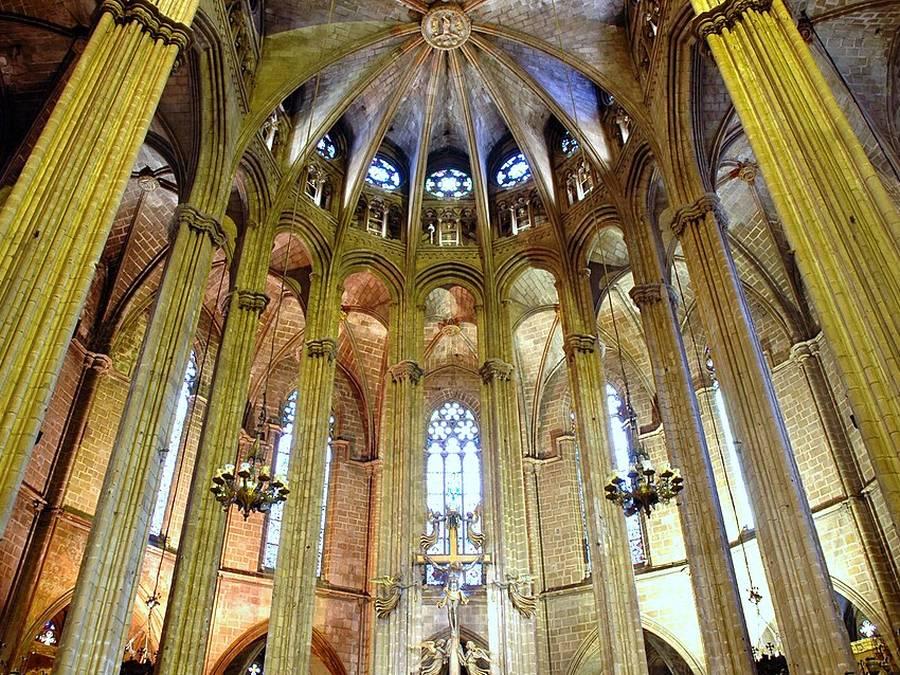
Vaults and pillars of the nave of Barcelona Cathedral
The nave and apse, beneath the Gothic vaults.Photo: Josep Renalias · CC BY-SA 3.0 · Wikimedia Commons
02
Must-seeInside

The nave and the chapels

Where
Entrance through the main door
Time on site
15 min

Inside, the contrast is complete: the 1913 façade opens onto an interior begun on 1 May 1298, under King Jaume II. It replaced a Romanesque cathedral consecrated in 1058, itself built over an early Christian basilica. The last bays of the nave date from the 15th century.

Catalan Gothic prefers width to height. The side chapels are set between the buttresses, with a gallery above. The nave therefore feels dark, almost low, and the light falls from the high stained-glass windows.

What to look for

  • The deliberate gloom: the windows are set high, above the chapels.
  • The painted keystones above the nave.
  • The Baroque altarpieces of the side chapels, added long after the Gothic building work.

The guide’s view

Give your eyes a minute to adjust to the darkness before walking on towards the choir.

03
Must-seeInsideWorship

The Chapel of the Holy Christ of Lepanto

Where
To the right of the main entrance
Time on site
5 min

The chapel was built in 1407 and served as the chapter house until 1676. It holds the Baroque tomb of Saint Oleguer, a 12th-century bishop of Barcelona, and the so-called Lepanto crucifix.

Tradition holds that this Christ was aboard Don John of Austria’s galley at Lepanto, in 1571. Its body is said to have twisted to dodge a cannonball. It is a legend, and it explains the statue’s swaying pose.

What to look for

  • The arched body of the crucifix.
  • The candles and votive offerings: the chapel remains an active place of prayer.

The guide’s view

The chapel is reserved for worship and prayer: enter in silence, with no flash photography.

04
Must-seeInside

The Golden Fleece choir

Where
In the middle of the nave
Time on site
15 min

The choir occupies the middle of the nave, enclosed by a marble screen. Its carved wooden stalls were begun in 1390.

Above them, the stall backs carry the painted coats of arms of the Knights of the Golden Fleece. Charles V, master of the order, convened them here in chapter in 1519. The shields were painted in 1517–1518 for the occasion. That of Henry VIII of England is among them.

What to look for

  • The painted coats of arms above the stalls.
  • The carvings on the pinnacles and on the misericords beneath the seats.
  • The 16th-century marble reliefs on the screen, by Bartolomé Ordóñez and Pedro Villar.

The guide’s view

Look for Henry VIII’s coat of arms: the search makes you study each stall instead of walking past the whole.

05
Must-seeInsideSeen from the nave

The crypt of Saint Eulalia

Where
Below the high altar, at the end of the nave
Time on site
5 min

A stairway leads down beneath the high altar to the crypt where Saint Eulalia, co-patron of Barcelona, lies. Her 14th-century alabaster sarcophagus is the work of an Italian workshop. The saint’s cult has been tied to the cathedral since the 9th century.

According to tradition, Eulalia was a girl from Sarrià martyred in Roman times, at the age of thirteen. Her story belongs to legend, but it explains the city’s winter festival and the cloister geese.

What to look for

  • The reliefs on the sarcophagus, which tell of the martyrdom.
  • The coins thrown by visitors at the foot of the stairs.

The guide’s view

The crypt is not on the official list of spaces in the visit: you see it from the top of the steps. Do not count on going down.

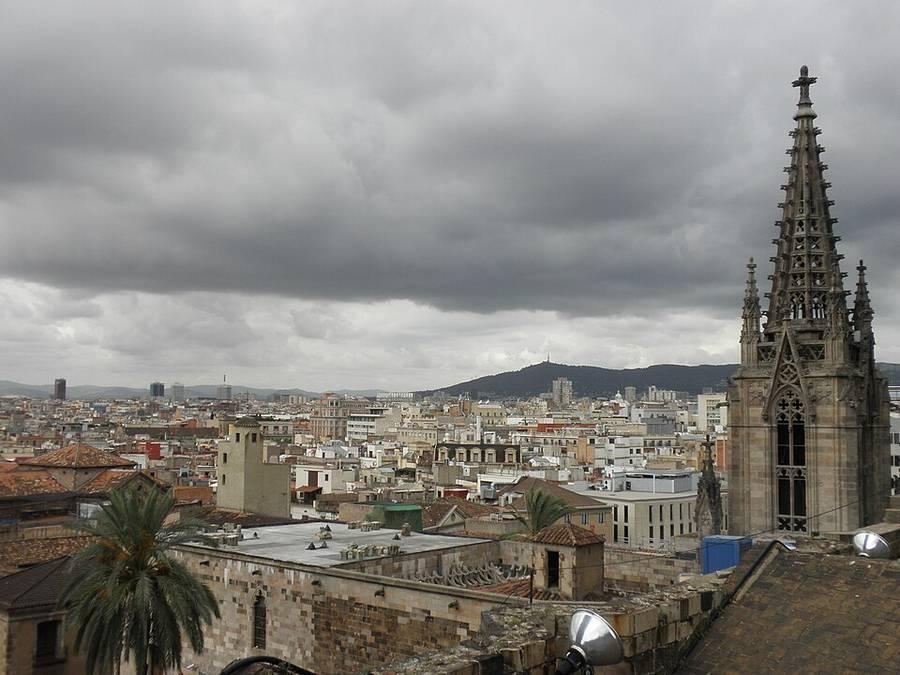
View of the roofs of Barcelona Cathedral and its spire
Barcelona seen from the cathedral roof terraces.Photo: Literat Tours · CC BY-SA 3.0 · Wikimedia Commons
06
Must-seeLift

The rooftops

Where
Lift in the Chapel of the Holy Innocents, near the Sant Iu door
Time on site
15 min

A lift climbs to the cathedral roofs. You walk between the bell towers, the central spire and the stone roofs, above the Barri Gòtic.

This is the viewpoint closest to the heart of the old city. The Sagrada Família to the north, the harbour to the south, Montjuïc to the west, and the roofs of the Generalitat below.

What to look for

  • The 1913 spire at close quarters: you can gauge the delicacy of the neo-Gothic stonework.
  • The two octagonal bell towers, from the 14th century.
  • The hidden terraces and courtyards of the quarter.

The guide’s view

Go up first if the sky is clear: the lift is narrow and the queue lengthens in late morning.

Gothic cloister of Barcelona Cathedral with its garden
The geese in the cloister, by the pond.Photo: Enric · CC BY-SA 4.0 · Wikimedia Commons
07
Must-seeInsideGarden

The cloister and its thirteen geese

Where
Reached from the nave
Time on site
15 min

The Gothic cloister, from the 14th and 15th centuries, surrounds a garden planted with palms, with a large pool. Chapels line three of its sides.

Thirteen white geese live in the pool. According to tradition, there is one for each year of Saint Eulalia’s life. They also served, it is said, as guards: a goose cries out when a stranger approaches.

What to look for

  • The geese, and the sign recalling their number.
  • The guilds’ tombstones on the gallery floors: scissors, shoes, tools.
  • The light filtered by the trees, very different from the gloom of the nave.

The guide’s view

The cloister is the pause in the route: sit in a gallery before moving on to the museum.

08
UnusualInside

The Fountain of Sant Jordi and the dancing egg

Where
In a corner of the cloister
Time on site
5 min

A small Gothic fountain, topped by a statue of Saint George, stands in a pavilion of the cloister. This is where the tradition of the ou com balla, the dancing egg, was born in 1637.

For Corpus Christi, an empty eggshell balances on the jet of water, in a garland of flowers and cherries. The custom later spread to several courtyards in the old city.

What to look for

  • The statue of Saint George at the top.
  • The jet of water that carries the egg at Corpus Christi.

The guide’s view

If you come in May or June, check the dates of the ou com balla. It is the only time the fountain resumes its role. The guide’s “Traditions and festivals” page says more.

09
Must-seeMuseum

The chapter house and Bermejo’s Pietà

Where
On the cloister side
Time on site
15 min

A former hall where soup was handed out to the poor, now a small museum. It holds a Romanesque baptismal font and Gothic paintings.

The masterpiece is Canon Desplà’s Pietà, painted in 1490 by Bartolomé Bermejo. The canon who commissioned it kneels beside the Virgin, in a landscape of rare precision for its time.

What to look for

  • The face of Canon Desplà, a realistic portrait of a man of 1490.
  • The background landscape, with its plants and animals.
  • The Romanesque baptismal font.

The guide’s view

The Pietà is small and often overlooked by groups in a hurry. Yet it is one of the great 15th-century paintings in Spain.

10
UnusualExhibition

Jewish memory in the cathedral

Where
On the visit route
Time on site
10 min

The cathedral borders the former Call, Barcelona’s Jewish quarter, destroyed in the violence of 1391. The chapter archives have kept documents that trace the history of its inhabitants, including an archive collection assembled in 1535.

The exhibition shows what the records of a Christian institution preserved, despite itself, of the community living a few metres away.

What to look for

  • The fragments of Hebrew texts in the documents on display.

The guide’s view

Follow the visit with the Call, five minutes’ walk away. The guide’s “Barri Gòtic on foot” page goes through its streets.

In this guide : Barri Gòtic on foot →

11
UnusualOutside

The Chapel of Santa Llúcia

Where
Corner of Carrer de Santa Llúcia and the Pla de la Seu
Time on site
5 min

A 13th-century Romanesque chapel, founded by Bishop Arnau de Gurb as the episcopal chapel, and still attached to the cloister. It opens onto both the street and the cloister.

It is the oldest building still standing around the cathedral: it tells of the architecture before the Gothic.

What to look for

  • The round-arched Romanesque doorway, with its capitals.
  • The contrast with the pointed arch of the cloister, right next to it.

The guide’s view

On 13 December, Santa Llúcia’s day, the chapel and the Christmas fair in front of the cathedral draw Barcelonans: come early.

OpenStreetMapGoogle Maps41.38360, 2.17620
12
UnusualOutsideFree

The Sant Iu door and Carrer dels Comtes

Where
North-east side, Carrer dels Comtes
Time on site
5 min

On the north-east flank opens the Sant Iu door, also known as the Santa Eulàlia door. Historians attribute its stone reliefs to 14th-century Italian artists.

Carrer dels Comtes then runs past the Palau Reial Major and the Museu Frederic Marès: you are at the centre of the Barcelona of the count-kings.

What to look for

  • The reliefs above the door.
  • The gargoyles on the side walls, older than the façade.

The guide’s view

From here, Plaça del Rei is two minutes away. Underground, the Barcelona History Museum (MUHBA) shows the Roman and early Christian remains on which the cathedral stands.

OpenStreetMapGoogle Maps41.38450, 2.17680
Cultural visit · €16

Pay, or come to Mass?

See everything, at your own pace

The nave, the cloister, the rooftops, the choir, the chapter house, the exhibition on Jewish memory and the Lepanto chapel. About 2 hours.

For whom: the only way to go up on the roofs, enter the choir and see Bermejo’s Pietà.

See the church at worship

Service · free entry

During Mass, you enter to attend the service. No walking round the chapels, no rooftops or museum, no photographs.

For whom: those who want to hear the organ and see the nave full, and are happy to stay seated. This is not a free visit.

Tickets and opening hours

Official prices 2026

TicketPriceFor whom
Individual€16Everyone
Reduced€14Students up to 25, large and single-parent families, with proof at the ticket desk
Group€8Per person
Free€0People with a disability of 33% or more, ICOM members

Cultural visit opening hours

DayOpenLast entry
Monday–Friday9:30–18:3017:45
Saturdays and eves of holidays9:30–17:1516:30
Sundays and religious holidays14:00–17:0016:30
Before you go