
Architecture and Modernisme · Place · checked on 04/11/2026
La Dreta de l’Eixample · Barcelona

La Pedrera, the house without load-bearing walls

Gaudí’s last civil building. A stone façade that carries itself, flats without a single straight wall, and a roof peopled by warriors. The visit takes an hour and a half if you take the time to read the structure.

  • 7stops
  • 1 hr 30visit

This guide follows the usual order of the visit: the façade, the courtyards, the lift to the roof, then down through the attic and the period apartment. The order may change with crowds and exhibitions.

Chimneys

28

Grouped in families, helmeted, clad in stone, lime or ceramic. These are the ones called the warriors.

Stair exits

6

The largest sculptures on the roof. They shelter the stairs rising from the courtyards; some are clad in trencadís.

Ventilation towers

2

They air the attic. Gaudí gives them the same look of lookouts as the chimneys.

Arches beneath your feet

270

Just below, the parabolic arches of the attic follow the undulations of the roof: the terrace is their back.

Status as of 04/11/2026

Winter hours since 2 November: 9:00–18:30 daily, night visits 19:00–23:00. The house will be closed on 25 December 2026 and from 11 to 17 January 2027.

The roof closes when it rains. The visit then goes ahead without it. Online tickets are neither refundable nor exchangeable, unless you take the €1.90 exchange insurance at purchase.

The Art Season hours are contradictory: its page states 9:00–20:30, last entry 19:00. Winter hours, however, close at 18:30. Check when you book.

In November, on Essential and Sunrise tickets bought online, with the code given on the official website.
−10 %
End of the Anselm Kiefer exhibition on the main floor, open since 2 October 2026.
24 Jan
Built for Pere Milà and Roser Segimon. Gaudí signed off the works on 31 October 1912.
1906–1912
Visitors since it opened to the public in 1996, according to the foundation that owns it.
29 million

The approach

The façade carries; the walls do not.

The stone façade supports itself, and iron beams tie it to the floors. Inside, columns and beams replace load-bearing walls: partitions can move. This is the free plan, twenty years before Le Corbusier made it a principle.

An apartment building that caused a scandal.

Pere Milà and Roser Segimon commissioned a rental building, with their own flat on the main floor. The works, from 1906 to 1912, exceeded the permitted heights. In 1909, the city finally recognised its monumental character, exempting it from the rules. The press mocked it, and so did the neighbours.

The Virgin who never went up.

Gaudí wanted to crown the façade with a large bronze Virgin of the Rosary. After the Tragic Week of 1909, when churches burned in Barcelona, Milà gave up any religious statue. The inscriptions on the cornice remain.

A second life of offices, bingo and exhibitions.

Roser Segimon sold the building in 1946. The attic was turned into studios in 1953; the main floor housed offices, then a bingo hall. The stone deteriorated. Caixa Catalunya bought the house in 1986, restored it and opened it in 1996. The Fundació Catalunya La Pedrera has owned it since 2013.

The route inside

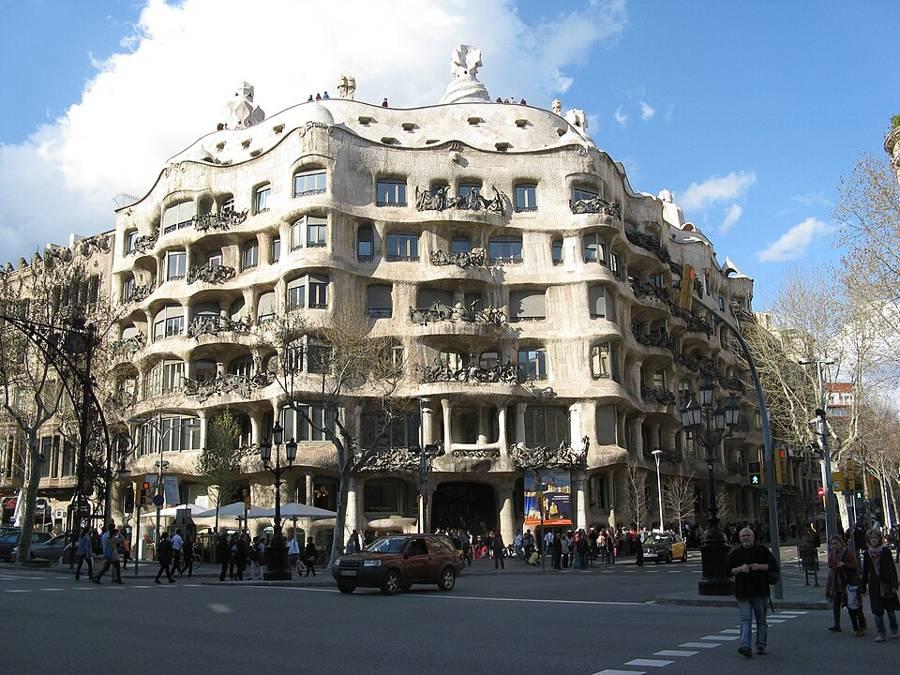
Undulating façade of Casa Milà on the corner of the Passeig de Gràcia
The stone façade and its wrought-iron balconies.Photo: Yair Haklai · CC BY-SA 4.0 · Wikimedia Commons
01
Must-seeGaudíOutdoorsFree

The façade from the corner of the Passeig

Where
Corner of Passeig de Gràcia and Carrer de Provença, opposite pavement
When
10 min before your time slot
Time
10 min

Look at the house from the other side of the junction. The stone façade undulates along two streets without a single sharp angle, like a cliff planed by the sea. Barcelonans in 1910 found it ugly and nicknamed it la Pedrera, the quarry.

This façade does more than clad the building: it carries its own load. Iron beams tie it to the floors; inside, there is no load-bearing wall.

What to look for

  • The wrought-iron balconies, like twisted seaweed, designed with Josep Maria Jujol.
  • The cornice at the top, where religious inscriptions survive.
  • The block’s cut corner: Gaudí turns it into the building’s prow.

The guide’s view

Keep this view in mind. Once on the roof, you will walk exactly above this undulating line.
OpenStreetMapGoogle Maps41.39540, 2.16200
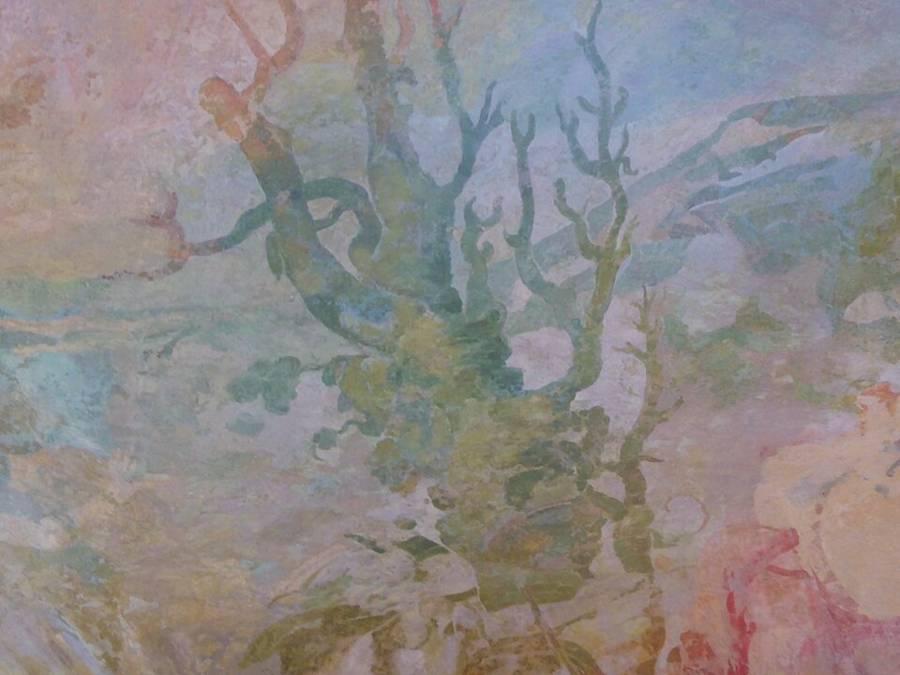
Plant-themed mural in a courtyard of Casa Milà
Mural in one of the courtyards: plants and pastel tones.Photo: Ardfern · CC BY-SA 4.0 · Wikimedia Commons
02
Must-seeGaudíIndoors

The two courtyards

Where
Ground floor, after the entrance
Ticket
All tickets
Time
10 min

The building is organised around two large courtyards open to the sky, which give the plan its figure-of-eight shape. They light and ventilate all nine levels, and served as entrances for horse-drawn carriages and motor cars alike.

Look up: the inner façades are painted, and the windows open wide, since no wall bears a load. This is where the house most resembles a living being.

What to look for

  • The cast-iron supports and the central beam, which guides call the soul of the building.
  • The murals in the entrance halls.
  • The iron gate of irregular scales, designed with Jujol.

The guide’s view

The two courtyards are not identical. Compare them: the larger faces the Passeig, the smaller faces Provença.

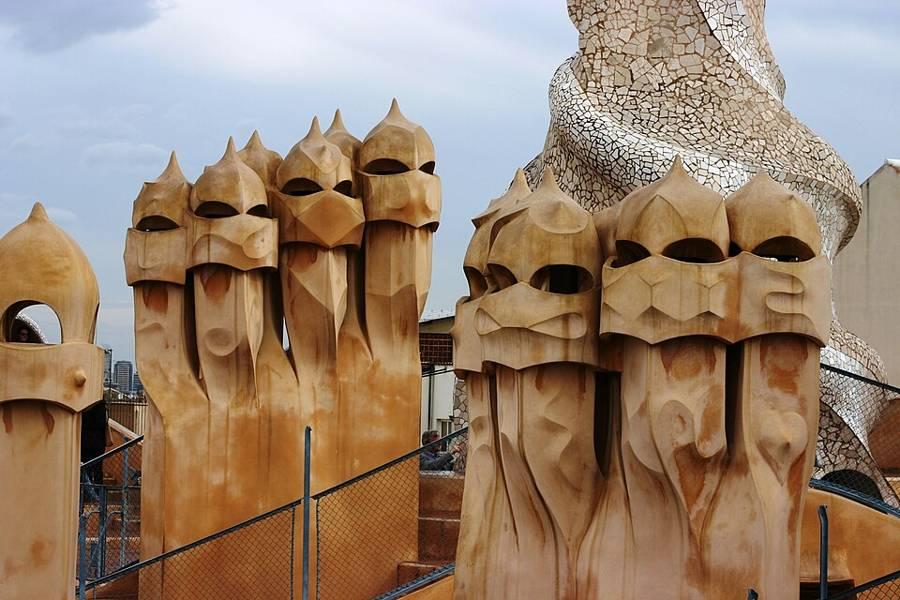
Sculpted chimneys on the roof of Casa Milà
The garden of warriors: chimneys and stair exits.Photo: José Luiz · CC BY-SA 3.0 · Wikimedia Commons
03
Must-seeGaudíOutdoors

The roof, the garden of warriors

Where
Roof, by lift
Ticket
All tickets; closed when it rains
Time
20 min

The lift goes straight up to the roof. The terrace follows the undulations of the façade, with stairs, walkways and different levels. Gaudí turns each technical element into sculpture.

There are 28 chimneys, two ventilation towers and six stair exits. The poet Pere Gimferrer called the whole “the garden of warriors”, as the helmeted chimneys look like sentries.

What to look for

  • The chimneys shaped like helmeted warriors.
  • The stair exits clad in trencadís, one of them in fragments of bottle glass.
  • The view of the Sagrada Família, framed by some of the arches.

The guide’s view

The roof closes as soon as it rains, with no refund. Check the day’s forecast and choose a slot in late morning or late afternoon. Low-angled light gives the warriors relief.

04
Must-seeGaudíIndoors

The attic, 270 arches

Where
Under the roof, the Espai Gaudí
Ticket
All tickets
Time
20 min

The attic housed the laundries and drying rooms. Gaudí covered it with 270 parabolic brick arches of varying heights, which follow the shape of the roof above. The space has often been compared to the skeleton of a whale.

Today, the attic houses the permanent exhibition on Gaudí: models, weighted chains used to calculate the arches, objects and furniture. In 1953 it had been turned into fourteen small flats, removed during the restoration.

What to look for

  • How the height of the arches varies from one end to the other.
  • The hanging-chain models, inverted in a mirror.
  • The high openings that ventilate the space.

The guide’s view

This is the most instructive part of the visit. If you have already seen the attic at Casa Batlló, compare: here, the arch becomes a forest.

05
Must-seeIndoorsReconstruction

The period apartment

Where
Fourth floor
Ticket
All tickets
Time
20 min

One flat in the building is furnished like that of a bourgeois family in the early 20th century. Drawing room, dining room, bedrooms, kitchen, maid’s room. The furniture is of the period but not original to the house.

This is where the free plan is easiest to grasp: no room is rectangular, the walls curve. Nothing prevented them from being moved, since they bear no load.

What to look for

  • The relief ceilings, which vary from room to room.
  • The layout, with reception rooms on the street and service rooms on the courtyard.
  • The door handles and joinery designed by Gaudí.

The guide’s view

Move quickly through the drawing room, where everyone stops. Take your time in the kitchen and the maid’s room: they show how the house really worked.

06
UnusualExhibitionArt Season ticket

The main floor and the Anselm Kiefer exhibition

Where
Main floor, the Milàs’ former apartment
Ticket
Art Season only
Time
30 min

The Milàs lived on the main floor. After Gaudí’s death, Roser Segimon had some of the suspended ceilings demolished to modernise the decor. The floor became an exhibition space in the early 1990s.

Until 24 January 2027, it hosts Anselm Kiefer’s first major solo exhibition in Barcelona, some forty works, in dialogue with the architecture.

What to look for

  • The undulating ceilings that survived the alterations.
  • The relationship between Kiefer’s monumental canvases and walls that are never straight.

The guide’s view

The exhibition requires the Art Season ticket, at €35. It is worth the difference if you know Kiefer; otherwise, save your time for the roof.

07
UnusualOutdoorsFree

On leaving, walk down to Casa Batlló

Where
Passeig de Gràcia, from no. 92 to no. 43
Time
10 min on foot

Casa Batlló is about 600 m away, down Passeig de Gràcia towards the sea. The two houses are almost contemporary and sum up Gaudí’s development. At the Batlló, colour and ornament; at La Pedrera, structure and bare stone.

On the way, the trencadís bench-lampposts on the Passeig are by Pere Falqués, not by Gaudí, whatever you may often hear.

What to look for

  • The hexagonal paving slabs on the pavement, decorated with marine motifs.
  • The bench-lampposts by Pere Falqués (1906).

The guide’s view

The guide’s page “Casa Batlló, the house of light” takes over from here. Visiting both on the same day means a lot of crowds: separate them with lunch.

In this guide : Casa Batlló, the house of light →

OpenStreetMapGoogle Maps41.39330, 2.16370
Essential · from €29

Which visit to choose?

The self-guided visit

Courtyards, apartment, attic and roof, with a video guide in 11 languages. Slots from 9:00 to 17:30.

For whom: the right choice for almost everyone. Take the first slot or one at the end of the day.

Before opening time

Sunrise · €39.50

Entry from 8:00 to 9:00, guided tour in English or Chinese, without the public.

For whom: photographers and those who want the roof empty. In November, the sun rises at around 7:20: the light is still low-angled.

The house by night

Night Experience · €39.50

Guided tour of 1 hr 20, video projection on the roof and a glass of cava. Sessions from 19:00 to 20:20.

For whom: a second visit. The show is popular, but architecture is hard to read in the dark.

Tickets and opening hours

Official online prices, November 2026

TicketPriceHoursWhat is included
Essentialfrom €299:00–17:30Self-guided visit, video guide; courtyards, apartment, attic, roof
Sunrise€39.508:00–9:00Guided tour without the public, in English or Chinese
Night Experience€39.5019:00–20:20Guided tour, projection on the roof, cava
Art Season€35see StatusSelf-guided visit and Anselm Kiefer exhibition
Open date€45your choiceSelf-guided visit with no fixed date
Premium€12015:30Guided tour in English, 6 people at most, reserved spaces, tasting

Combined tickets

WithPrice
Recinte Modernista de Sant Paufrom €42
Palau de la Música Catalanafrom €42
Teatre-Museu Dalí, Figueresfrom €44.50
Before you go