
Architecture and Modernisme · Place · checked on 04/11/2026
Sant Pere · Barcelona

Palau de la Música Catalana, the hall of glass

A concert hall lit by daylight, built for a choir and turned into a manifesto of Catalanism. Its decoration is the richest in all Modernisme; it tells a single idea, Catalonia singing with Europe.

  • 10stops
  • 50 minguided tour
  • €24the guided tour
  • Metro L1L4Urquinaona

This guide follows the order of the official guided tour, from the street to the rehearsal hall. Allow fifty minutes for the tour, plus a quarter of an hour outside for the façade.

Status as of 04/11/2026
Tours in the morning and early afternoon only.

Tours depart between 9:00 and 15:30, with separate times for each language. They may change with concerts and rehearsals: access to the stage is only guaranteed “subject to availability”.

Box-office surcharge, amount to be confirmed.

The official website announces a surcharge on any ticket bought on site. It is €1 on the guided-tour page and €2 on the self-guided page. Buy online: you avoid both the surcharge and the queue.

Guided tour; €20 for under-35s or over-65s; €14 for residents of Catalonia; free for under-10s.
€24
Length of each tour option, guided, self-guided or audio-guided.
50 min
Inaugurated on 9 February, after three years of building work.
1908
Seats in the concert hall; more than two thousand according to the Enciclopèdia.
≈ 2,200

The approach

A palace built for a choir.

The Orfeó Català, a choir founded in 1891 by Lluís Millet and Amadeu Vives, commissioned a home from Lluís Domènech i Montaner. The building went up from 1905 to 1908, largely funded by subscriptions from members and patrons, and was inaugurated on 9 February 1908. It still belongs to the Orfeó.

A hall of glass.

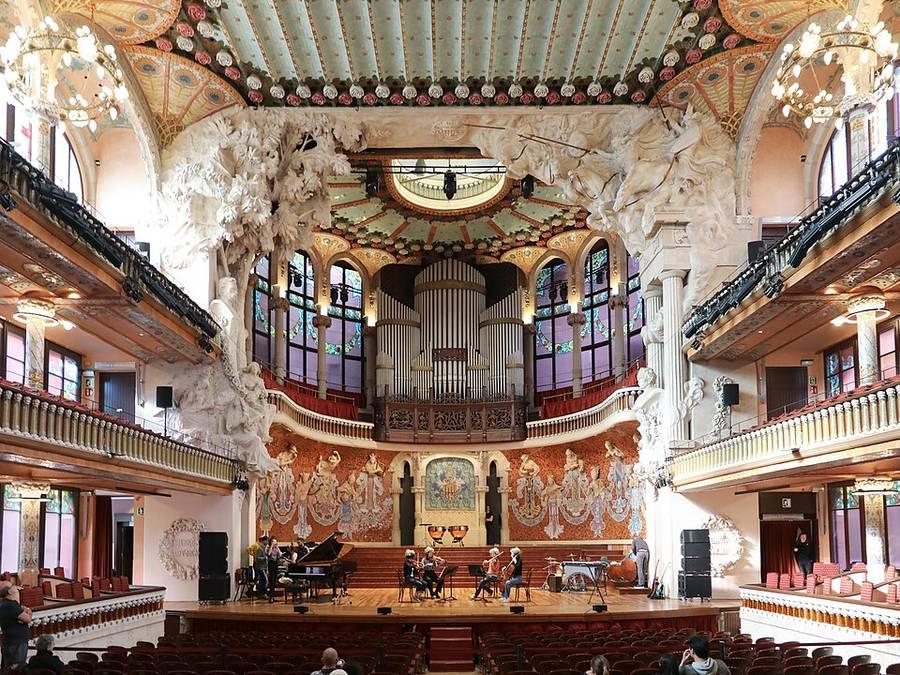
Thanks to a metal frame, Domènech freed the walls, replaced them with stained glass and opened the ceiling with a skylight. The concert hall is lit by daylight. UNESCO inscribed it on the World Heritage List in 1997, together with the same architect’s Hospital de Sant Pau.

A political building.

The decoration pairs Catalan folk song with the great music of Europe: it is a manifesto of cultural Catalanism. On 19 May 1960, during a visit by Franco to Barcelona, part of the audience sang the Cant de la Senyera, banned that evening. Jordi Pujol, arrested afterwards, was sentenced to seven years in prison by a military court.

A scandal that shook Catalonia.

In July 2009 the Catalan police raided the Palau. Its president, Fèlix Millet, and its director, Jordi Montull, had embezzled €23 million. The investigation also showed that the construction firm Ferrovial paid kickbacks, disguised as sponsorship, through the Palau to the Convergència Democràtica de Catalunya party. The Supreme Court upheld the convictions on 30 April 2020.

The route inside

Two stops outside, seven inside in the order of the guided tour, and the Petit Palau, which opens only for concerts. Tick “Seen” as you go: the page remembers it on this phone.

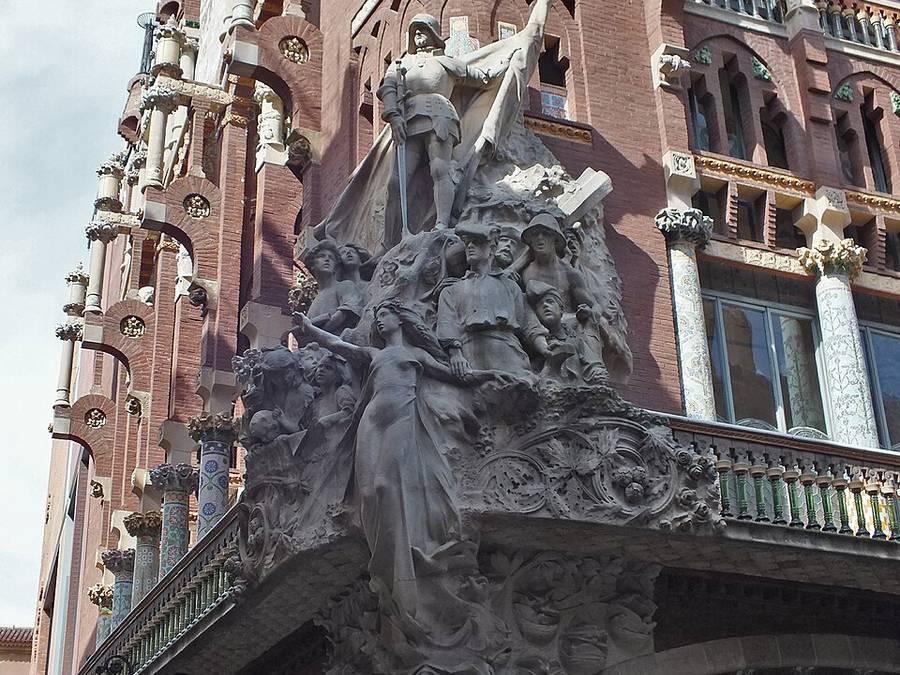
Sculpture group of Catalan folk song on the corner of the façade
Miquel Blay’s group on the corner of the two streets, with Saint George at the top.Photo: amaianos · CC BY 2.0 · Wikimedia Commons
01
Must-seeOutdoorsFree

The corner façade and the Cançó popular

Where
Corner of Carrer de Sant Pere més Alt and Carrer d’Amadeu Vives
Time on site
10 min, before the tour

The Palau is wedged into the narrow streets of Sant Pere. Domènech i Montaner designed it to be seen at an angle, looking up. On the corner, Miquel Blay’s sculptural group, La cançó popular catalana, depicts the people singing, under the protection of Saint George.

Higher up are busts of composers (Palestrina, Bach, Beethoven) and a large mosaic by Lluís Bru depicting the Orfeó Català, the choir that owns the building. The message is set out from the street: learned music and folk song under one roof.

What to look for

  • Saint George at the top of Blay’s group, and the figures of the people below: fishermen, old men, children.
  • The columns of the first-floor balcony, each covered in a different floral mosaic.

The guide’s view

The best viewpoint is the opposite pavement of Carrer de Sant Pere més Alt. The street is too narrow to take it all in from the foot of the building.
OpenStreetMapGoogle Maps41.38758, 2.17523
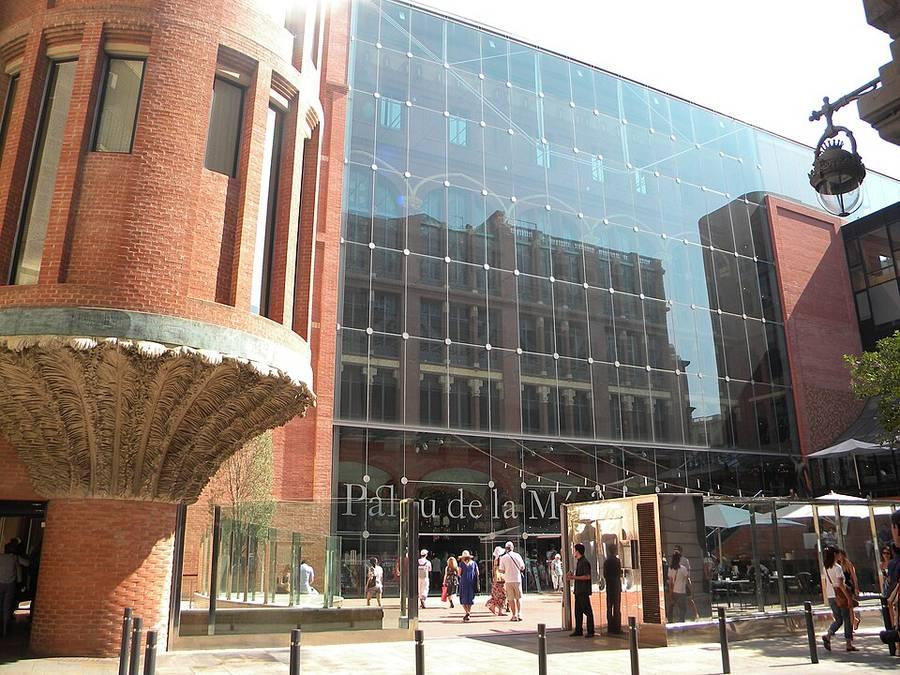
Glass façade of the contemporary extension next to the brick façade
Òscar Tusquets’s glass extension, to the right of the 1908 brick façade.Photo: Pili Redondo Rodríguez · CC BY-SA 3.0 es · Wikimedia Commons
02
UnusualOutdoorsFree

Òscar Tusquets’s glass façade

Where
Carrer del Palau de la Música, tour-entrance side
Time on site
5 min

The tour entrance is through the contemporary extension. In the 1980s, and again in 2004, the architect Òscar Tusquets enlarged the Palau and cleared a square in front of the side façade. His glass and brick building houses dressing rooms, archives and offices.

The extension reveals the original façade rather than hiding it. The contrast between the brick of 1908 and today’s glass is part of the visit.

What to look for

  • Domènech’s side façade, now visible from the square.
  • The ticket office and entrance, housed in the extension.

The guide’s view

Arrive here a quarter of an hour before your slot: ticket checks and security take place in the extension.

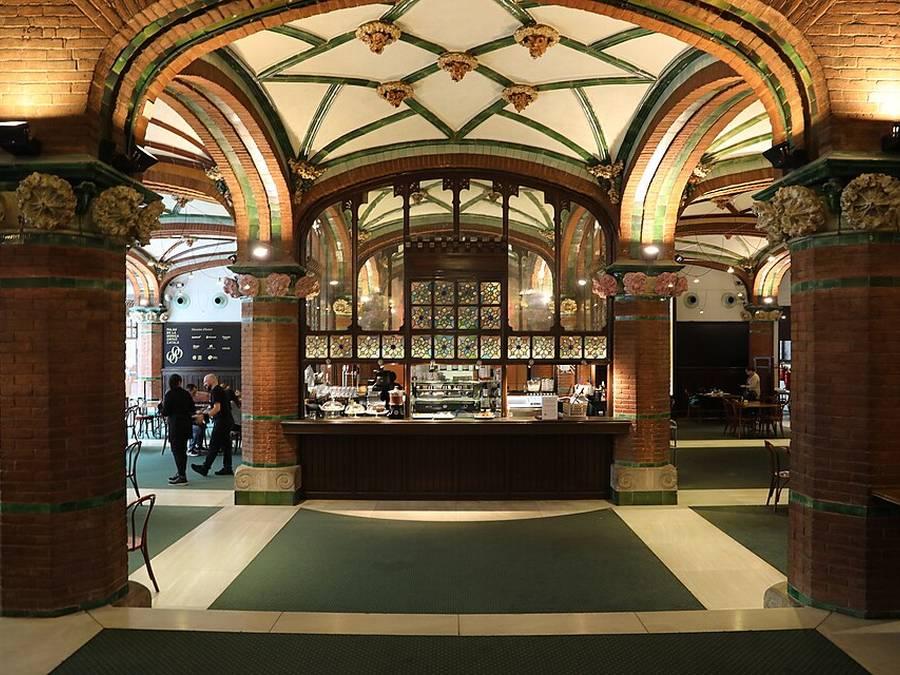
Foyer of the Palau with brick arches and a bar
The foyer, now the Cafè Palau: brick arches and ceramic capitals.Photo: Francesco Bini · CC BY-SA 4.0 · Wikimedia Commons
03
Must-seeGround floorCafé

The foyer

Where
Ground floor
Time on site
5 min; Cafè Palau from 9:00 to midnight

A forest of exposed-brick pillars, crowned with ceramic capitals, carries the upper floors. This is the former entrance hall, now the Cafè Palau, open every day except Christmas and New Year.

Domènech left the brick visible instead of hiding it under render. It is the building’s basic material, the one the decoration then covers.

What to look for

  • The brick arches and the ceramic capitals.
  • The display case holding the banner of the Orfeó Català.

The guide’s view

The café offers a second chance to see the foyer, after the tour or before a concert.

Banister of the grand staircase with glass balusters
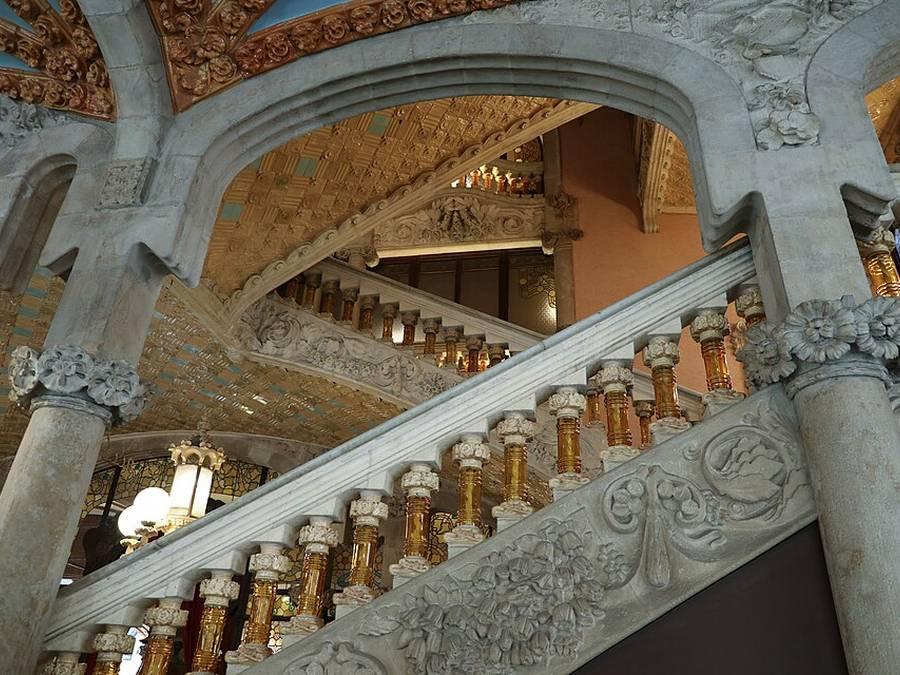
The banister of the grand staircase and its yellow glass balusters.Photo: Francesco Bini · CC BY-SA 4.0 · Wikimedia Commons
04
Must-seeFirst floorDecoration

The grand staircase

Where
From the foyer to the first floor
Time on site
5 min

A monumental staircase climbs to the hall, beneath a ceramic ceiling decorated with roses. The banister is made of yellow glass balusters, lit by the light from the façades.

As everywhere in the Palau, the metal frame frees the walls: the staircase is bathed in natural light.

What to look for

  • The glass balusters of the banister.
  • The ceramic roses on the ceiling, a motif that recurs throughout the building.

The guide’s view

Stay at the back of the group on the stairs: photographs are easier without the crowd in front.

Sala Lluís Millet with large windows and a chandelier
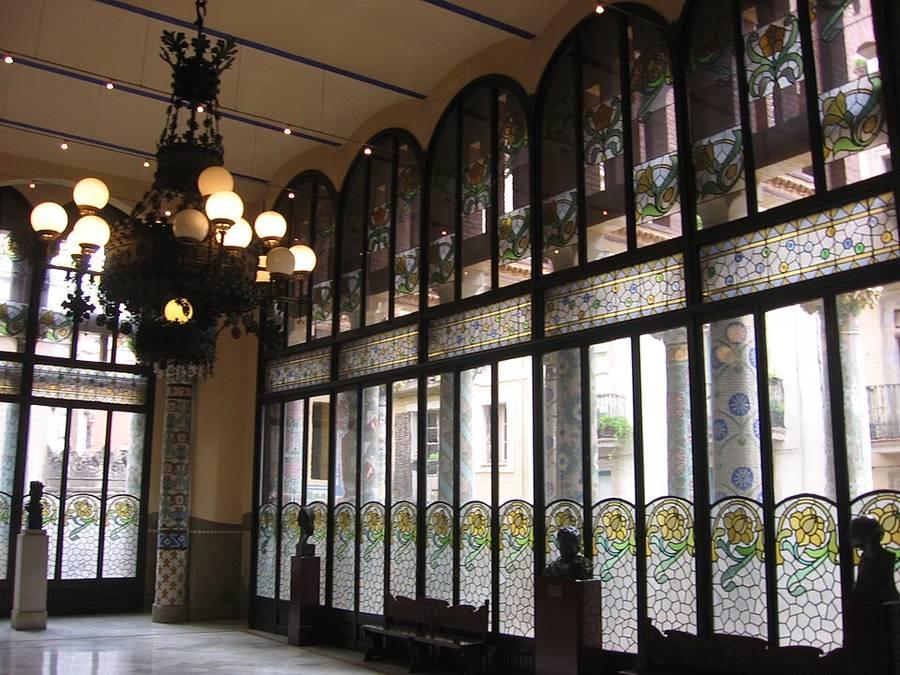
The Sala Lluís Millet, its windows onto the balcony and its chandelier.Photo: Canaan · CC BY-SA 3.0 · Wikimedia Commons
05
Must-seeFirst floorBalcony

The Sala Lluís Millet

Where
First floor, Sant Pere més Alt side
Time on site
10 min

The great reception room bears the name of Lluís Millet, founder of the Orfeó Català. Wrought iron, tiles, mosaic, glass and wood: every material of Modernisme is gathered here, beneath a chandelier of about 300 kg.

The windows open onto the balcony of the main façade. From here you see up close the mosaic-covered columns glimpsed from the street.

What to look for

  • The balcony columns, at eye level.
  • The bronze busts of musicians, in the room.

The guide’s view

Step out onto the balcony if the guide suggests it: it is the only place where you can almost touch the façade.

Central skylight in the ceiling, shaped like an inverted golden dome
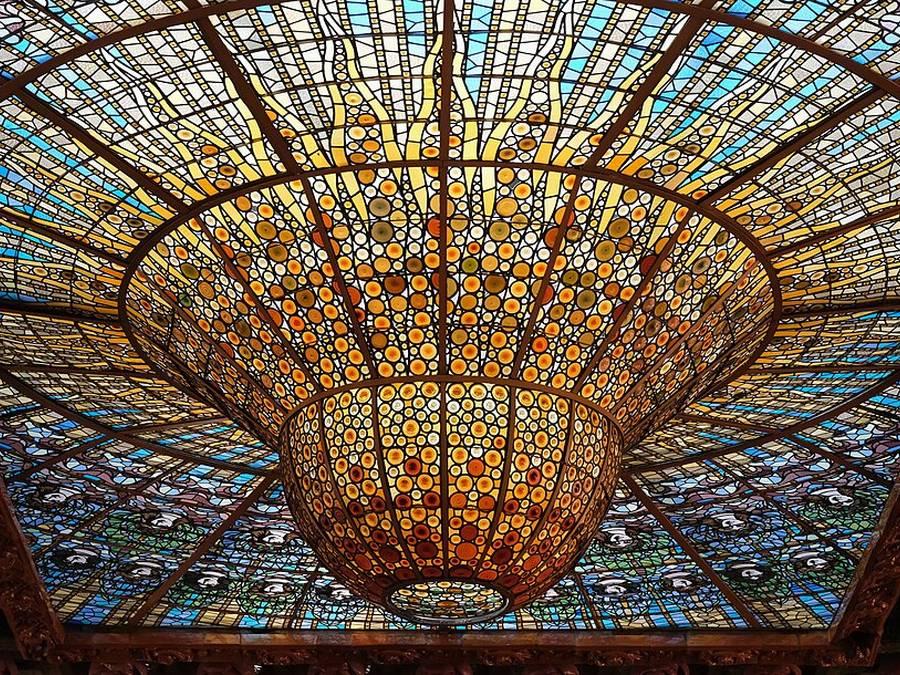
Antoni Rigalt’s skylight: a golden sun ringed with blue.Photo: Alvesgaspar · CC BY-SA 4.0 · Wikimedia Commons
06
Must-seeConcert hallUNESCO

The concert hall and its skylight

Where
First floor, stalls or first balcony
Time on site
20 min, seated presentation

The hall of about 2,200 seats is a glass box. The side walls are stained glass, and in the ceiling a skylight by Antoni Rigalt forms a golden sun, ringed with blue and the faces of women singers. Daylight enters from every side.

The decoration takes up the rose again, sculpted by the thousand throughout the building. Beside the stage, the Walcker organ has more than 3,700 pipes.

What to look for

  • The sun of the skylight, seen from the centre of the hall.
  • The side windows, whose colours change with the hour.

The guide’s view

Visit in the morning in clear weather if you can: the hall only makes sense with light streaming through the glass.

Stage and carved proscenium arch, with the organ behind
The proscenium arch: Clavé on the left, Beethoven and the Valkyries on the right.Photo: Francesco Bini · CC BY-SA 4.0 · Wikimedia Commons
07
Must-seeConcert hallSculpture

The proscenium arch

Where
Framing the stage
Time on site
During the presentation

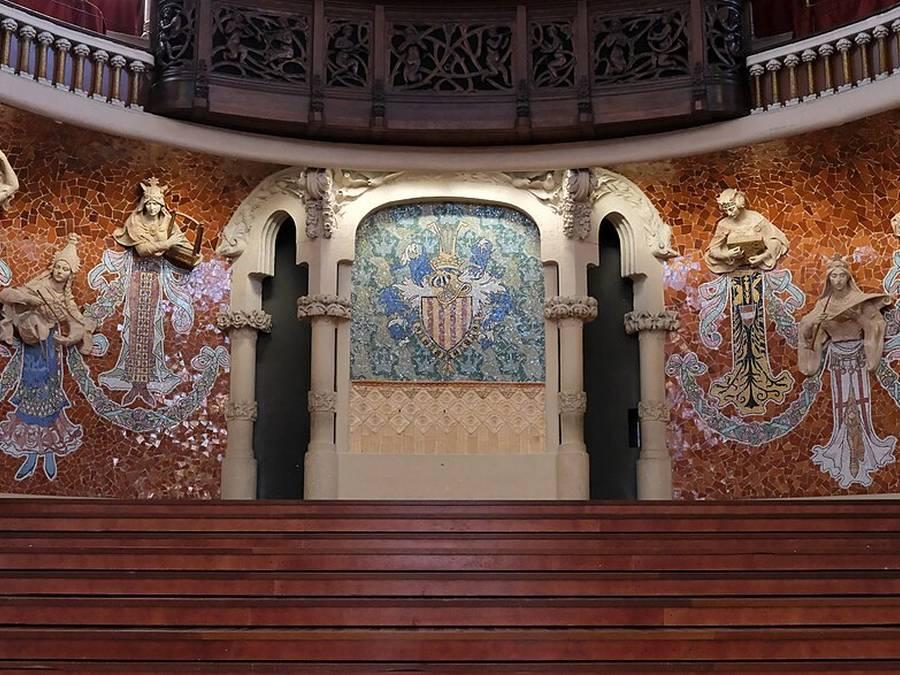
Two plaster sculptural groups, by Dídac Masana and Pau Gargallo, frame the stage. On the left, the bust of Josep Anselm Clavé, founder of the Catalan workers’ choirs, beneath a tree and flowers: this is folk song. On the right, Beethoven, beneath Wagner’s Ride of the Valkyries: this is learned European music.

The arch restates the façade’s programme on a grand scale: Catalonia sings with Europe.

What to look for

  • The contrast in movement between the two sides: calm on the left, the Valkyries’ gallop on the right.

The guide’s view

Look at the arch from the back of the hall: up close, you see only details.

Back wall of the stage with the Muses in relief and mosaic
The Muses of the stage wall, half relief, half mosaic.Photo: Alvesgaspar · CC BY-SA 4.0 · Wikimedia Commons
08
Must-seeConcert hallMosaic

The eighteen muses

Where
Back wall of the stage
Time on site
During the presentation

Eighteen young women, each playing a different instrument, form a semicircle behind the stage. The upper bodies are sculpted in relief by Eusebi Arnau, the lower halves are mosaic by Lluís Bru: they literally emerge from the wall.

They accompany every concert: the orchestra plays before a silent ceramic chorus.

What to look for

  • The instruments, all different: look for the harp, the tambourine, the flute.
  • The shift from relief to mosaic, at the figures’ waists.

The guide’s view

If the stage is open, the guide will say so; it depends on the day’s rehearsals.

09
UnusualGuided tour onlyBasement

The Orfeó Català rehearsal hall

Where
Beneath the concert hall
Practical
Included in the guided tour, not in the self-guided tour

Beneath the great hall Domènech placed the choir’s workspace, the very purpose of the building. The Orfeó Català still rehearses here.

The contrast with the hall above is deliberate: restraint below, apotheosis above.

What to look for

  • The ceiling, which carries the floor of the concert hall.

The guide’s view

This is the main reason to choose the guided tour over the self-guided one.

10
UnusualConcerts onlyUnder the square

The Petit Palau

Where
Beneath the extension’s square
Practical
Not open to visitors; open for concerts and talks

A second hall, inaugurated in 2004, dug beneath the square of Tusquets’s extension, eleven metres below ground. Some sources give its capacity as 538 seats, others as 600.

It hosts chamber music and the free “Parlem de…” talks, held an hour before some concerts of the 2026-2027 season.

What to look for

  • The entrance, from the square, if you come to a concert.

The guide’s view

The pre-concert talks are free, subject to available seats: a chance to enter the Palau in the evening without a ticket.

To understand

Tour or concert

Three ways in, which do not show the same thing.

The guided tour

Fifty minutes with a guide, in a group, in the language chosen at purchase, English included. It is the only option that includes the Orfeó Català rehearsal hall, and sometimes the stage.

For whom: a first visit. This is the option to take if you only do one.

The self-guided or audio-guided tour

At your own pace

The same route without the rehearsal hall, with a digital guide on your phone. Self-guided €20, audio-guided €24; your own earphones are required for the audio guide.

For whom: those who want to linger beneath the skylight. The audio guide costs as much as the guided tour without its advantage: the self-guided tour is the better of the two.

A concert

To listen

The only way to hear the acoustics and see the hall full. Programmes and prices are published concert by concert on the Palau website. In the evening the stained glass is dark: the hall loses what makes it unique.

For whom: music lovers, as a complement to the tour rather than a substitute.

Tickets and times

Official prices, November 2026

VisitorGuidedSelf-guidedAudio-guided
General€24€20€24
Under 35, over 65€20n/an/a
Residents of Catalonia€14n/an/a
Disability below 65 %€13€10€12
Family pack (2 adults, 2 young people up to 16)€72€60n/a
Accompanied under-10s; disability of 65 % or more, with a companionfreefreefree

n/a: not stated on the official page for that option.

Before you go