
Traditions and festivals · Overview · checked on 04/11/2026
Barcelona

Traditions and festivals

Human towers, dancing giants, devils running through the crowd, a city that gives itself roses and books. In Barcelona, festivals are a matter of neighbourhood, calendar and identity.

  • 13festivals
  • 4traditions
  • 5places

This page gives the keys, then the calendar of the year. Choose the month of your stay: the list keeps only what happens while you are here.

Status as of 04/11/2026

All Saints’ Day is over, Christmas is coming. The Fira de Santa Llúcia sets up in front of the cathedral in late November. Its 2026 dates had not been published on 4 November. The Christmas lights also go on in late November: in 2025, they were switched on on 22 November on the Passeig de Gràcia.

End of the temporary exhibition “La Gresca” at the Casa dels Entremesos.
22 Nov.
Start of the Llums de Sant Pau, the Christmas light installation in the Recinte Modernista, until 10 January.
19 Nov.
The Three Kings’ parade, the next big street festival.
5 Jan.
Santa Eulàlia, the winter festival, with castells and correfoc in the old town.
12 Feb.

The keys

The calendar

Movable dates (carnival, Easter, Corpus Christi, neighbourhood festivals) change every year: check them in the city’s listings before you travel.

janv.févr.marsavr.maijuinjuil.aoûtsept.oct.nov.déc.Une année13 fêtesReisTres TombsSanta EulàliaCarnestoltesPasquaSant JordiCorpusSant JoanNadalCastanyadaLa MercèDiadaGràciadate fixedate mobile, selon l’année
The year to scale: each day takes up the same angle. A dot marks a fixed date, a solid line a festival lasting several days. A dotted line marks the window in which a movable feast falls from year to year (Carnival, Easter, Corpus Christi). Tap a name to read its entry.
Month of your stay
5 and 6 JanuaryIn season

Reis

The Three Kings

Where
The Kings arrive by sea at the Moll de la Fusta, then parade through the centre

On the evening of 5 January, the Kings’ parade crosses the city from the harbour. Children receive their presents the next morning; those who have misbehaved find sugar coal. People share the tortell, a brioche ring hiding a bean and a figurine.

The guide’s view

The parade draws hundreds of thousands of people: arrive an hour early, and avoid the Via Laietana with a pushchair.
mid-JanuaryIn season

Tres Tombs

The Three Rounds of Sant Antoni

Where
Ronda de Sant Antoni and the streets of the district

For the feast of Saint Anthony, patron of animals and muleteers, horses, carriages and carts parade. They go three times round the Sant Antoni district. The festival recalls the days when the city lived at the pace of draught animals.

The guide’s view

The parade passes the Sant Antoni market: combine it with a vermut.

around 12 FebruaryIn season

Santa Eulàlia

Barcelona’s winter festival

Where
Plaça de Sant Jaume and the old town

The feast of the young martyr from Sarrià, co-patron of the city, honoured long before La Mercè. It is La Mercè in winter and on a smaller scale. Giants parade, castells rise on Plaça de Sant Jaume on Sunday, and a correfoc closes the festival. On 12 February, the saint’s penó, the city’s old banner, hangs from the balcony of the city hall.

The guide’s view

Fewer people than at La Mercè, and the same castells: the best window of the year to see them up close.

February or MarchIn season

Carnestoltes

Carnival

Where
Neighbourhood parades; Sitges for the big carnival

Catalan carnival opens with Dijous Gras, the day of botifarra d’ou and coca de llardons. It closes with the burial of the sardine. In Barcelona, the festival happens mainly in the neighbourhoods; the region’s great carnival is in Sitges.

The guide’s view

For a spectacle, take the train to Sitges on the Sunday or on Shrove Tuesday.

March or AprilIn season

Setmana Santa i Mona

Holy Week and the Easter mona

Where
The city’s pastry shops, which display their monas in the window

Holy Week processions exist in Barcelona, but they are more discreet than in Andalusia. On Easter Monday, godparents give their godchildren the mona. This cake is increasingly replaced by a chocolate sculpture.

The guide’s view

Tour the windows of the great pastry shops in the week before Easter: it is a competition in all but name.

23 AprilIn season

Sant Jordi

The day of the book and the rose

Where
La Rambla, the Passeig de Gràcia and every square

The patron saint of Catalonia, slayer of the dragon. People give each other a rose and a book, and the city fills with stalls; authors sign books in the street. It is not a public holiday, yet it is the most widely observed festival of the year. The Catalan tradition partly inspired UNESCO’s World Book Day.

The guide’s view

On 23 April, Casa Batlló, decked with roses, and the Palau de la Generalitat, open to the public, draw huge queues. Come early or head for the small squares.

May or JuneIn season

Corpus i l’Ou com balla

Corpus Christi and the dancing egg

Where
Cathedral cloister, courtyards of the old town

For Corpus Christi, an empty eggshell dances, balanced on the jet of the fountains. Cloisters and courtyards are crowned with flowers and cherries. The tradition, recorded at the cathedral since the 17th century, has spread to several patios in the old town.

The guide’s view

The fountains are decorated for only a few days: check the list and times on the city’s website.

evening of 23 JuneIn season

Revetlla de Sant Joan

Midsummer Night

Where
Beaches and neighbourhood squares

The shortest night is celebrated until morning, with bonfires, firecrackers and fireworks. People eat coca de Sant Joan, with cava. The Canigó flame, lit at the top of the mountain, is carried throughout Catalonia. 24 June is a public holiday.

The guide’s view

The beaches are packed and noisy until dawn, and firecrackers go off everywhere: keep pets and young children indoors.

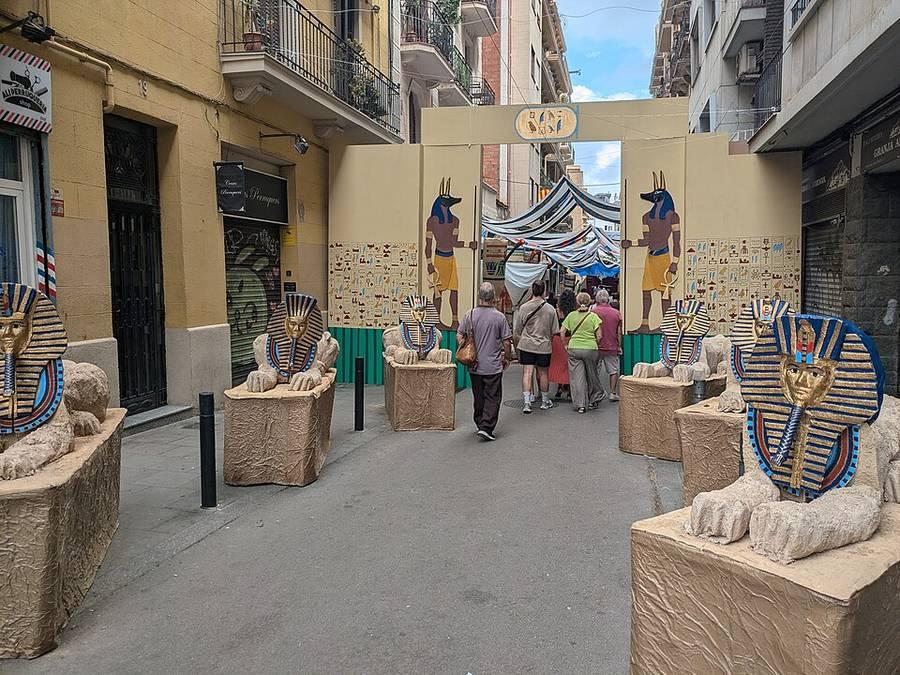
Street in Gràcia decorated for the neighbourhood festival
Carrer Puigmartí decorated for the Festa Major de Gràcia 2024.Photo: KRLS · CC BY-SA 4.0 · Wikimedia Commons
mid-August, one weekIn season

Festa Major de Gràcia

The festival of decorated streets

Where
Streets and squares of Gràcia

Each street in Gràcia is decorated on a theme, with recycled materials, after months of work by residents. A jury chooses the finest. Concerts, street meals and castells fill the district for a week. Sants follows with its own festival a few days later.

The guide’s view

Visit the decorated streets by day, when they can be read; in the evening, the festival becomes a crowd.

In this guide : Gràcia on foot →

11 SeptemberIn season

Diada Nacional

Catalonia’s national day

Where
Monument a Rafael Casanova, Fossar de les Moreres, city centre

Catalonia commemorates the fall of Barcelona in 1714 and the loss of its institutions. In the morning, wreaths at the monument to Rafael Casanova; in the afternoon, demonstrations, often pro-independence since 2012. Public holiday.

The guide’s view

A political occasion: observe without joining in. The guide’s page “The State of the Autonomies” explains the context.

around 24 SeptemberIn season

La Mercè

The city’s great festival

Where
Plaça de Sant Jaume, old town, Montjuïc, beaches

Barcelona’s patronal festival lasts four to five days. Giants’ parade, castells on Plaça de Sant Jaume, a giant correfoc, free concerts, fireworks over the sea. 24 September is a public holiday.

The guide’s view

The Mercè diada castellera, on the Sunday, brings together the best colles. Arrive on the square an hour early, or watch from the neighbouring streets.

31 October and 1 NovemberIn season

Castanyada i Tots Sants

All Saints and chestnuts

Where
Pastry shops and chestnut sellers

On the eve and day of All Saints, people eat roast chestnuts, sweet potatoes and panellets, with a sweet wine. Chestnut sellers (castanyeres) set up in the streets from October. The festival is giving way to Halloween among children, but not in the pastry shops.

The guide’s view

Chestnuts are sold until December: look for the small braziers on street corners.

late November to 6 JanuaryIn season

Nadal, el tió i el caganer

Catalan Christmas

Where
Fira de Santa Llúcia, Avinguda de la Catedral; lights around the city

The Fira de Santa Llúcia, in front of the cathedral, sells nativity scenes, figurines and moss. Here you find the caganer, the little figure relieving himself in a corner of the crib. Children feed the tió, a log with a face. On Christmas Eve, they beat it while singing so that it “produces” presents. 26 December, Sant Esteve, is a public holiday.

The guide’s view

The caganer comes as a footballer or a politician: it is the most Catalan souvenir you can take home.

The four traditions to recognise

Castell raised on the Plaça de Sant Jaume
A castell on the Plaça de Sant Jaume, at La Mercè 2004.Photo: Jordiferrer · CC BY-SA 3.0 · Wikimedia Commons
enxanetaacotxadordosostronc · 4 × 3pinya, la baseUn 3 de 73 par étage, 7 étages
UNESCO 2010

The castells

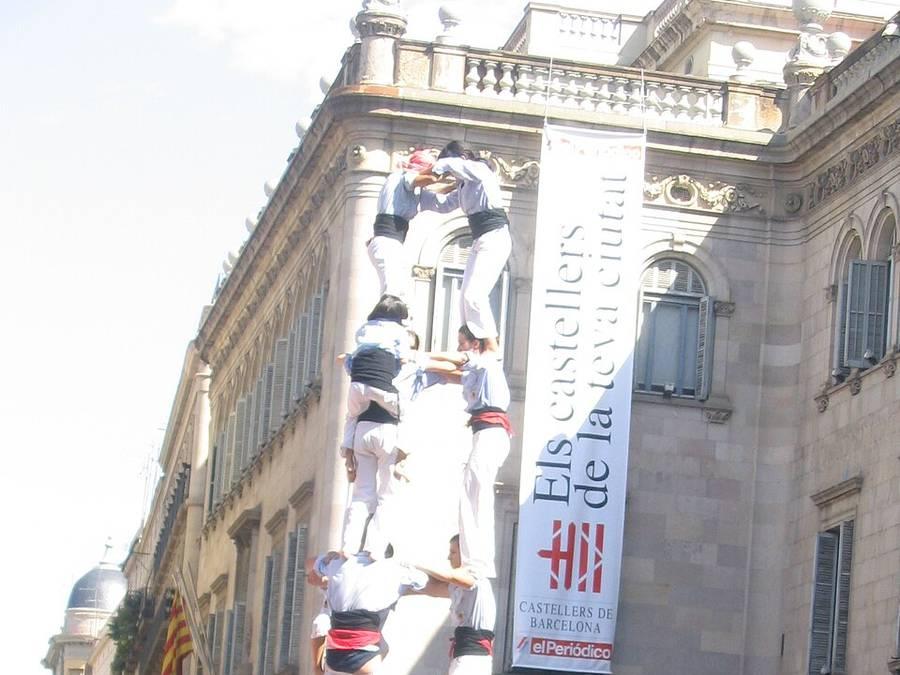
Human towers of six to ten levels, built by a colla of several hundred people. The base (pinya) supports the levels; a helmeted child, the enxaneta, climbs to the top and raises a hand. The castell only counts as a success if it is dismantled without falling.

What to look for

  • The pinya, where strangers from the crowd can be seen lending a hand.
gegantle porteur, sous la jupecapgròsun passant
Seguici

Gegants i capgrossos

The giants, figures several metres tall carried by a person hidden under the skirt, dance in pairs. The capgrossos, or big heads, accompany them. Each neighbourhood has its own. The city’s parade at La Mercè and Santa Eulàlia, with the eagle, the dragon and the other beasts of the bestiary.

What to look for

  • The giants’ dances as they spin on the spot, skirts flaring.
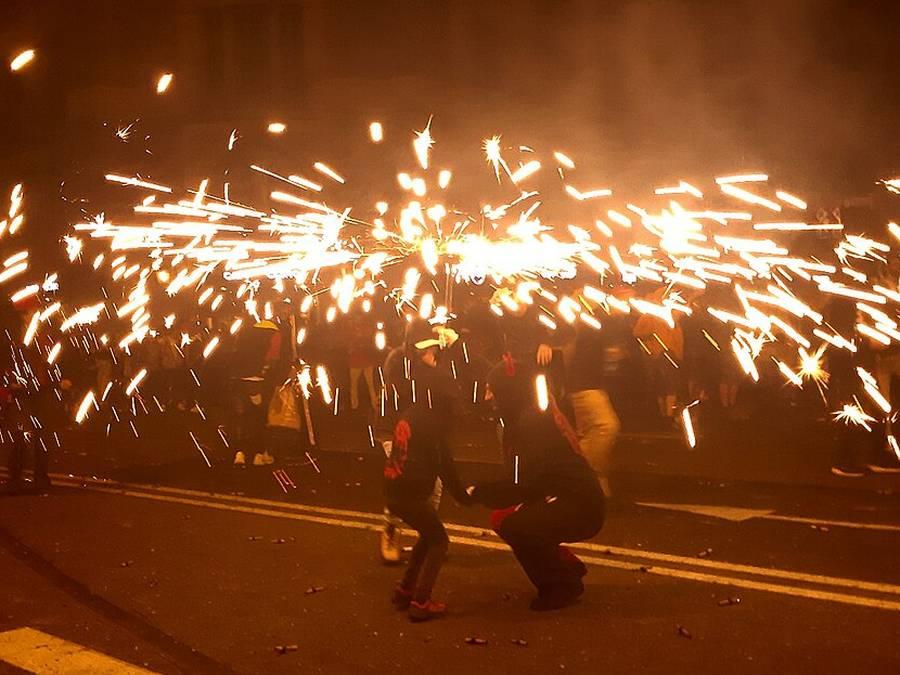
Devils throwing sparks during a correfoc
A correfoc on Via Laietana, in 2019.Photo: MagdaLena7 · CC BY-SA 4.0 · Wikimedia Commons
chapeaulunettesbouchons d’oreillefoulard en cotonmanches longues, cotonpantalon longchaussures ferméesSous le feujamais de synthétique
Fire

The correfoc

Devils and iron beasts armed with firecrackers and rockets run through the crowd. You can watch from a distance or run beneath the sparks: that is the point. Participants cover up in cotton clothing, a hat and glasses.

What to look for

  • The fire beasts, dragons and víbries, spitting showers of sparks.

The guide’s view

To run beneath the sparks: cotton clothing, never synthetic, long sleeves and trousers, a scarf, hat, glasses, earplugs and closed shoes. No glass, and keep children away from the front row (advice repeated by betevé for La Mercè).

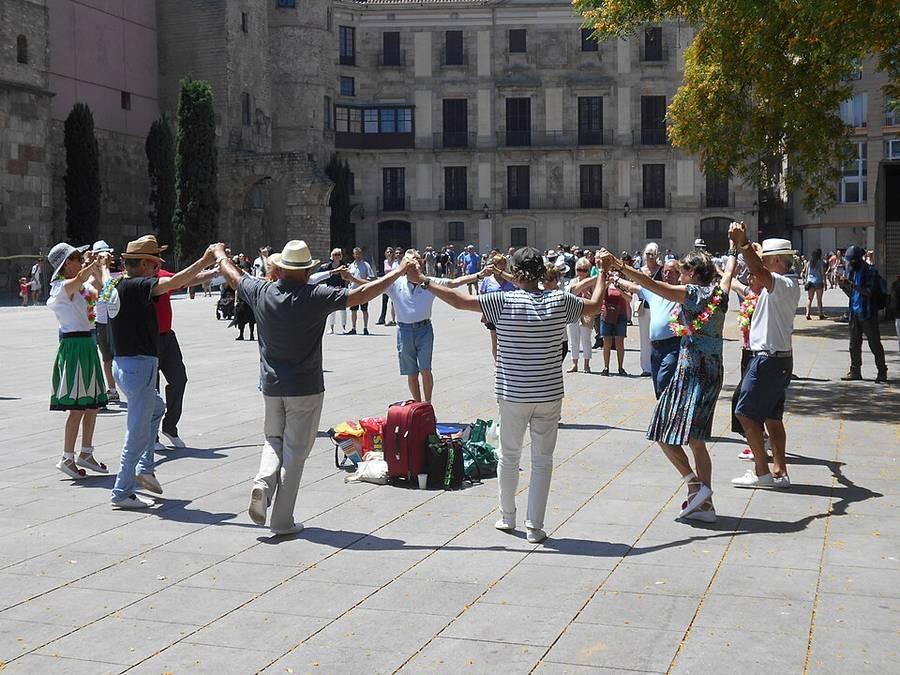
Sardana dancers in a circle in front of the cathedral
A sardana circle on the Pla de la Seu, in front of the cathedral.Photo: Canaan · CC BY-SA 4.0 · Wikimedia Commons
les sacsVue du cielMains levées
Dance

The sardana

A slow, precise circle dance, hands joined and raised, played by a cobla of around ten musicians. Tolerated but watched under Francoism, it became a Catalan sign of recognition. Anyone can join the circle, provided they count the steps.

What to look for

  • The bags placed in the centre of the circle, and the dancers counting under their breath.

Where to see it

Places where festivals can be seen all year round, not only on festival days. Coordinates come from OpenStreetMap.

Must-seeFestival stage

Plaça de Sant Jaume

Address
Between the city hall and the Palau de la Generalitat
Practical
Public space

The square where the castells of La Mercè and Santa Eulàlia are raised, where the giants parade and where the great sardanas are danced.

In this guide : Barri Gòtic on foot →

OpenStreetMapGoogle Maps41.38260, 2.17700
Must-seeGiants

La Casa dels Entremesos

Address
Plaça de les Beates, 2
Practical
Tue.–Sat. 10:00–13:00 and 16:00–19:00; Sun. and public holidays 11:00–14:00; closed on Mondays. Price not stated

The home of the giants, dwarfs and beasts of the old town, on close display all year round. A temporary exhibition, “La Gresca”, runs here until 22 November 2026.

OpenStreetMapGoogle Maps41.38610, 2.17680
Must-seeSardanas and Christmas

Avinguda de la Catedral

Address
In front of the cathedral
Practical
Public space; Fira de Santa Llúcia from late November to Christmas

The esplanade of the weekend sardanas and the Santa Llúcia Christmas market. The dates of the dances change: check the city’s listings.

OpenStreetMapGoogle Maps41.38490, 2.17610
UnusualRehearsals

Local dels Castellers de Barcelona

Address
Carrer de Bilbao, 212, Sant Martí
Practical
Ask for rehearsal days (934 982 729, colla@castellersdebarcelona.cat)

The premises of the city’s oldest colla. Attending a rehearsal, on a weekday evening, shows the training a castell demands.

OpenStreetMapGoogle Maps41.41130, 2.19240
UnusualNeighbourhood festival

Plaça de la Vila de Gràcia

Address
Gràcia
Practical
Public space

The heart of the Festa Major de Gràcia in August, and the best example of Barcelona neighbourhood life for the rest of the year.

In this guide : Gràcia on foot →

OpenStreetMapGoogle Maps41.40020, 2.15760

Before you go