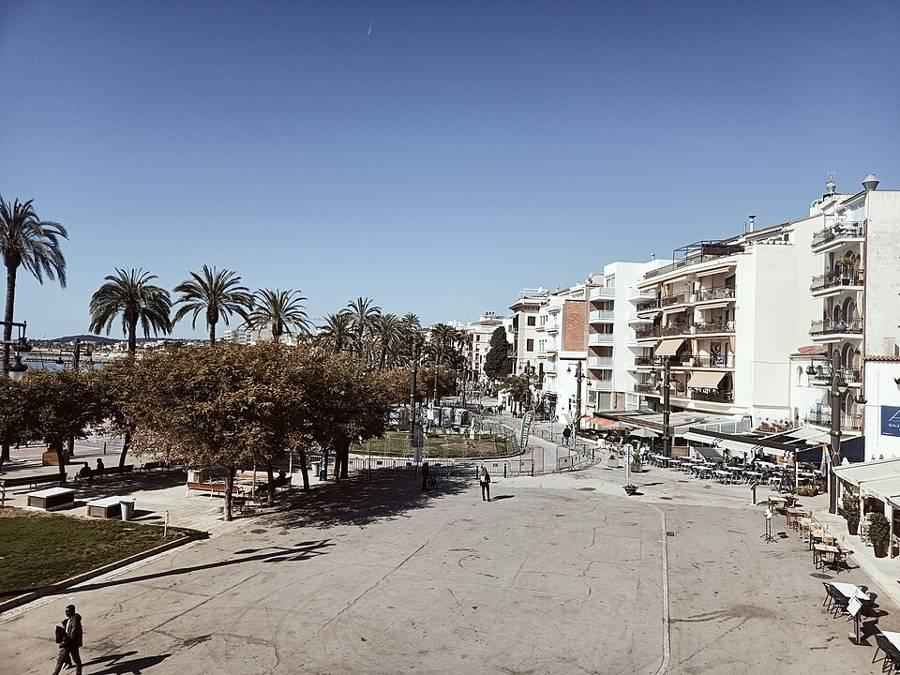
In walking order from the station. Tick “Seen” as the day goes on: the page remembers on this phone.
- Address
- Carrer de l’Illa de Cuba, between the station and the Cap de la Vila
- Practical
- Public street
- Time
- 10 min
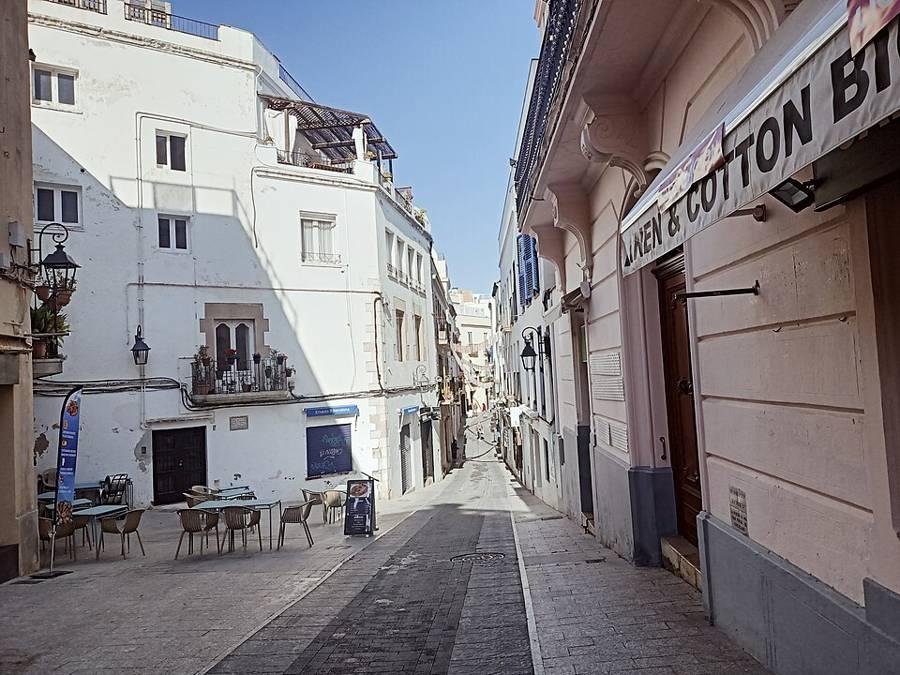
The street name tells where the town’s money came from in the 19th century. Hundreds of Sitgetans left to make their fortune in Cuba and Puerto Rico, in trade, sugar or rum. They were called americanos or indianos. Those who returned built houses with eclectic façades, gardens, iron balconies and sometimes a palm tree by the door.
The most famous of them was born in Sitges in 1814: Facundo Bacardí Massó. He left for Santiago de Cuba, where in 1862 he founded the rum brand that bears his name.
What to look for
- The dates and initials carved above the doors, which mark an emigrant’s return.
- The glazed galleries and ironwork, rare in the old fishing town.
The guide’s view
Look up rather than at the shop windows: the 19th-century façades begin on the first floor.
Straight on towards the sea: 150 m, 3 min to the Cap de la Vila.
- Address
- Plaça del Cap de la Vila
- Practical
- Pedestrian square, the shopping heart of town
- Time
- 15 min
The “end of the town” marks the edge of the old village. From here run Carrer Major, which leads to the church and the town hall, and Carrer de Parellades, a shopping street parallel to the sea.
Sitges remains a town of about 30,000 people, whose population triples or quadruples in summer. In November, the centre returns to the pace of a small town.
What to look for
- The long view down Carrer Major towards the sea, which keeps the layout of the old town.
The guide’s view
Buy what you need for the day here: beyond the Punta, shops become scarce.
Right along Carrer de Sant Gaudenci: 150 m, 3 min to Can Llopis.
- Address
- Carrer de Sant Gaudenci, 1
- Practical
- Closed for works as of 4 November 2026, no reopening date
- Time
- 5 min
The Llopis family house, built at the end of the 18th century, shows the life of a well-to-do Sitges family in the 19th century. Drawing rooms, library, wine cellar, mechanisms and automata.
The Consorci del Patrimoni de Sitges closed it to install air conditioning and redo the displays. The reopening announced for 2020 did not happen, and the museums’ website still shows a temporary closure.
What to look for
- The sober façade, with none of the ornament of the neighbouring americanos’ houses: this is the home of an old local family.
The guide’s view
Do not make a special detour. Check museusdesitges.cat before your visit: the reopening will be announced there.
Back to the Cap de la Vila, then Carrer de Sant Francesc and Carrer d’Àngel Vidal: 300 m, 5 min.
- Address
- Carrer d’Àngel Vidal
- Practical
- Private society; the façade is visible
- Time
- 5 min
Sitges has two casinos, El Retiro and the Prado Suburense, born of a rivalry between two societies in the 19th century. Each had its balls, its theatre and its loyal members; you belonged to one or the other.
The rivalry lives on at Carnival, one of the most popular in Catalonia: the two societies hold their own parties and parades.
What to look for
- The façade and the sign, on a narrow street where it is easy to walk past without noticing.
The guide’s view
If a poster announces a concert or a ball open to the public, that is the only way in.
Towards the sea along Carrer d’en Bosc: 200 m, 3 min to Plaça de l’Ajuntament.
- Address
- Plaça de l’Ajuntament
- Practical
- Stämpfli: Sat and Sun 10:00–14:00. €7
- Time
- 15 min, 45 with the foundation
The town hall stands on the site of Sitges castle. On the same square, the Fundació Stämpfli shows international contemporary art. It grew up around the Swiss painter Peter Stämpfli, who gave part of his work to the town.
Next door, the Casa Bacardí, the rum brand’s visitor centre, has been closed since March 2021. The group closed it “until further notice” during the pandemic.
What to look for
- The statue of Facundo Bacardí, a reminder of the link between the town and Cuba.
The guide’s view
The foundation opens only on weekend mornings: if you come on a Saturday or Sunday, go in before the Cau Ferrat.
A few steps up towards the Punta: 60 m, 1 min.
- Address
- La Punta, Carrer de Fonollar
- Practical
- Parish church; opening hours to be checked
- Time
- 15 min
The 17th-century Baroque church stands on the Punta, the rock that divides the town’s two beaches. It is the outline on every Sitges postcard: a pale façade and a bell tower, set above the sea.
The esplanade around it, with its old cannons, was the village’s defensive point against raids from the sea.
What to look for
- The view west, over the curve of the Ribera and the beaches as far as the Vinyet.
- The church seen from below, from the Fragata beach, late in the day.
The guide’s view
Come back at sunset, around 17:30 in November: the façade catches the light full on.
Carrer de Fonollar, behind the church: 100 m, 2 min to the Cau Ferrat.
- Address
- Carrer de Fonollar, 8
- Practical
- Nov–Mar: Tue–Sun 10:00–17:00. Closed on Mondays. €12 with the Museu de Maricel
- Time
- 1 hr
In 1893 the painter and writer Santiago Rusiñol bought two fishermen’s houses facing the sea and made them his studio and home. From 1892 to 1899 he staged the Festes Modernistes, which made Sitges a centre of Catalan Modernisme. They drew Ramon Casas, Miquel Utrillo and the young Picasso.
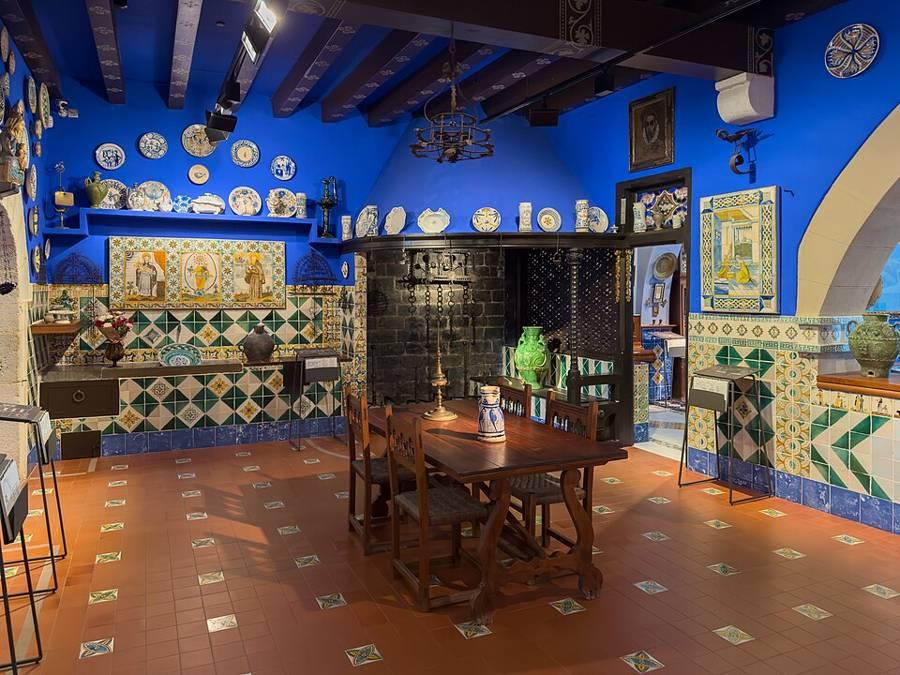
Rusiñol amassed ironwork, ceramics, glass and paintings here. The house became a museum after his death, in 1933, and keeps the dense hang he wanted.
What to look for
- The two canvases by El Greco, which Rusiñol had carried in procession through the town in 1894.
- The collection of wrought iron that gave the house its name: the “den of iron”.
- Works by Ramon Casas and Picasso, from the Quatre Gats years.
The guide’s view
On the first Wednesday of the month, entry is free for all. The ticket also covers the adjoining Museu de Maricel: do both in one go.
Next door, same ticket.
- Address
- Carrer de Fonollar
- Practical
- Museu: Tue–Sun 10:00–17:00. Palau: guided tours on Sundays, 10:00 (English), 11:00 and 12:00 (Catalan), 13:00 (Spanish). €12 each
- Time
- 1 hr, 2 hr with the Palau
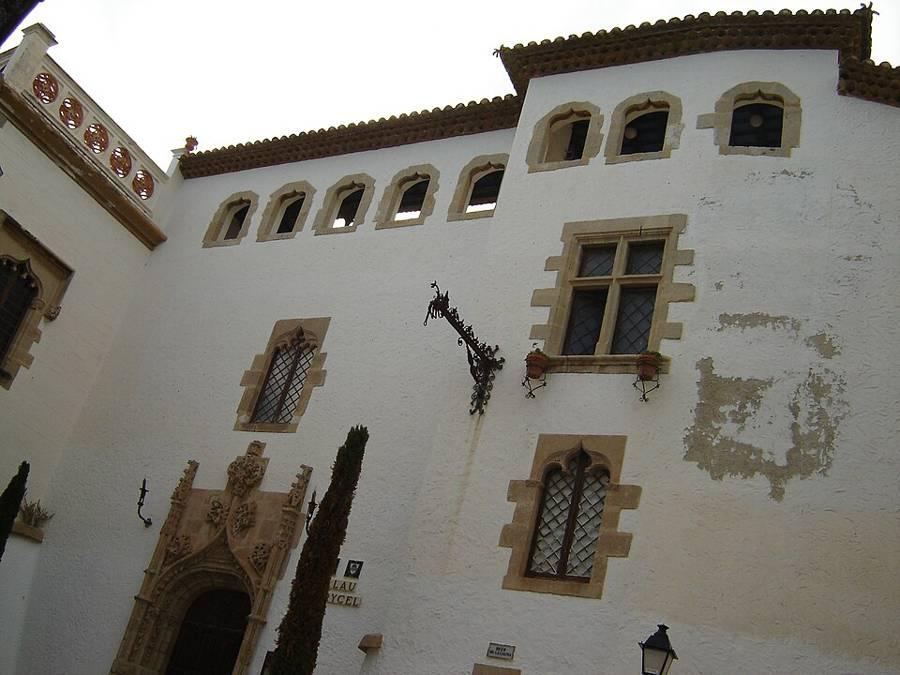
The American industrialist Charles Deering, a friend of Rusiñol, had Maricel built from 1910 to 1918 with the help of Miquel Utrillo. The palace joins old houses and the town’s hospital. He installed his art collection there; after falling out with Utrillo, he left Sitges in 1921 and took most of it with him.
The Museu de Maricel now presents Catalan art from the Middle Ages to the 20th century, with a sea view from almost every room. The Palau, with its salons and cloister above the sea, can only be visited with a guide, in small groups.
What to look for
- The footbridge that spans the street and links the two parts of Maricel.
- The cloister open to the sea, in the Palau.
The guide’s view
Book the Palau tour in advance: groups are small, and in winter this is the only day of the week it opens.
Under the footbridge, a few steps towards the sea: 30 m.
- Address
- Behind Maricel, above the sea
- Practical
- Public space
- Time
- 10 min
A small viewpoint at the end of the street, between the walls of Maricel and the sea. This is the “corner of calm”: people arrive by chance and stay longer than planned.
From here you can see Sant Sebastià beach and, in the distance, the port of Aiguadolç.
What to look for
- The sea front of Maricel, with its arches and mullioned windows, redone in a Gothic style imagined in the 20th century.
The guide’s view
The best place for a pause between the two museums and the beach.
Down eastwards to Sant Sebastià beach: 200 m, 3 min.
- Address
- Platja de Sant Sebastià; cemetery at the end of Passeig de la Benaigua
- Practical
- Cemetery open during the day; opening hours to be checked
- Time
- 30 min
The eastern beach is more sheltered and more local than the Ribera. Above it, the old Sant Sebastià cemetery faces the sea. It holds the tombs of the town’s families, including americanos who grew rich in the Americas.
The mausoleums tell the same story as the façades of Illa de Cuba.
What to look for
- The most ornate 19th-century family vaults, those of the families back from Cuba.
The guide’s view
The cemetery is a place of contemplation: visit it without group photos.
Back via the Punta, then the whole Passeig de la Ribera westwards: 1.1 km, 19 min.
- Address
- Passeig de la Ribera
- Practical
- Public promenade; Fragata, Ribera and Bassa Rodona beaches
- Time
- 30 min
The palm-lined seafront promenade runs along the central beaches. It made Sitges a seaside resort from the late 19th century, when the railway linked the town to Barcelona.
Since the 1960s, Sitges has also been one of Europe’s leading LGBTQ+ destinations. The Bassa Rodona beach has long been its symbol. In October the town also hosts the International Fantastic Film Festival, founded in 1968.
What to look for
- The church on the Punta, at the end of the promenade, with the sea in the foreground.
The guide’s view
At sunset, walk from west to east to keep the church in the light.
Continue west along the Passeig Marítim: 1.1 km, 19 min to the Vinyet.
- Address
- Carrer d’Antoni Muntañola, 43
- Practical
- Sanctuary; opening hours to be checked
- Time
- 15 min
The sanctuary of the Mare de Déu del Vinyet, the town’s patron, lies to the west, amid what were once vineyards. The present chapel dates from the 18th century.
Sitges fishermen and sailors left ex-votos here in thanks for a safe return from sea.
What to look for
- The maritime ex-votos, ship models and paintings, if they are on view inside.
The guide’s view
To get back, allow 25 min on foot to the station, or take a town bus.