Car + rack railway
- Free car park at Monistrol-Vila station (≈ 1,000 spaces), then the rack railway up to the monastery.
- Alternative: the monastery car park, ≈ €6.50/day, with a steep walk up.
- Arrive before 9:30 at weekends, or queue at the Cambril.


One day for the essentials, a second for the Montserrat the coaches never see. Ruined hermitages, a Romanesque church painted by Sean Scully, a saltpetre cave and a deserted western flank.
Online guides copy outdated information. Here is what could be verified at the end of October 2026.
(breakdown, no reopening date). The Santa Cova is reached on foot from the monastery: 1.7 km downhill, about 25 min, and the same back up.
(since May 2023). The Moreneta is visited by timed slot. A combined ticket for basilica, Moreneta and museum is quoted at €18 online, €20 on site. This price comes from a third-party site: check on montserratvisita.com.
Salve and Virolai at 13:00 Monday to Friday, at 12:00 on Sundays and feast days. The choir is on break from late June to late August; in October, it sings.
The Santa Cova path has reopened after safety works.
On this route, a car is not a luxury. Santa Cecília, the Collbató caves and the Can Maçana flank are not served by train.
| Place | Mon | Tue–Fri | Sat | Sun |
|---|---|---|---|---|
| Basilica and Moreneta | Timed slots | Timed slots | Timed slots | Timed slots |
| Escolania (Salve and Virolai) | 13:00 | 13:00 | No singing | 12:00 |
| Museu de Montserrat | 10:00–17:45 | 10:00–17:45 | 10:00–17:45 | 10:00–17:45 |
| Santa Cecília | Not published | Not published | Not published | Not published |
Go on a weekday: the Escolania sings at 13:00 and the queue for the Moreneta stays reasonable. Saturday combines no singing with the heaviest crowds. If you go at the weekend, choose Sunday and arrive before 9:30.
Basilica and Santa Cecília opening times not verified online on 5 November. Book your Moreneta slot on the monastery website. The Escolania does not sing from 29 June to 26 August 2026, nor on 25–26 June and 29 August.
Sources : Guide page “montserrat-carnet-de-route (checked 21/10/2026)”, status checked on 4 and 5 November 2026
Designed for a Tuesday to Friday: the Escolania sings and crowds are thinner. Ascent on foot ≈ 350 m, most of the climb being done by funicular.
15 minutes, 600 m of ascent. Sit on the right going up for the view over the Llobregat.
Take the first Cambril slot. Then the atrium, the façade, and the Ave Maria (the candle path) behind.
Walk down (the funicular is closed). Chapel open 10:30–17:00. Allow 1 hr 30 there and back, including the visit.
An hour is enough for the painting galleries and the Egyptian section.
Be inside by 12:40 at the latest. The singing lasts about ten minutes.
Abat Cisneros if you want to sit down; the producers’ market for a picnic on the summit.
Up to ≈ 1,000 m. Viewpoint and geopark interpretation centre at the upper station.
≈ 1 hr almost on the level, then 10 min of steps. Return the same way, or descend straight to the monastery by the Camí Vell and the Pla de Santa Anna (sound knees required).
The cross is 20–30 min from the monastery. Santa Cecília is a 5-min drive along the BP-1103, but its opening times are not reliably published: phone ahead.
This programme is full. If you keep only one thing, keep Sant Jeroni in fine weather, not the Moreneta. The Cambril queue on a Saturday can exceed an hour for a few seconds before the statue. And on a day of low cloud, give up the summit: you will pay for the funicular to look at white.
Day 2 · off the beaten track · a Saturday or Sunday
Morning at the Collbató caves (weekend visits only in October), then the Tebaida hermitage loop in late morning. Santa Cecília in the afternoon, sunset at the Coll de Can Maçana. Detailed entries follow below.
Positions plotted from the coordinates in the heritage inventory (Diputació de Barcelona). A scale diagram, not a hiking map.
Catalans also call it Montsagrat, the sacred mountain. Before it was a monastery, Montserrat was a desert of hermits, then a European pilgrimage site, then a national symbol. All three layers can still be read on the ground.
9th–10th c.
Solitaries live in the caves and on the ledges. The cult of Mary predates the monastery.
1025–1811
A major pilgrimage, a printing press, a music school. Montserrat lends its name to churches as far as the Americas.
1811–1844
War against Napoleon, then the confiscation of Church property: almost no monks remain.
1844 – today
Restoration, patronage of Catalonia, a refuge for the language and the opposition under Franco.
One Saturday at dusk, shepherds see a light descend on the mountain and hear singing. The Bishop of Manresa finds an image of the Virgin in a cave, which cannot be moved. A chapel is built on the spot: this is the Santa Cova. The story was first written down in 1239, three and a half centuries after the supposed events.
Count Guifré el Pelós grants the hermitage of Santa Maria to the monastery of Ripoll. This is the first written mention of Montserrat.
Abbot Cesari founds a Benedictine community on the eastern slope. It predates Santa Maria by eighty years and long rivals it.
Abbot of Ripoll and Bishop of Vic, Oliba is a major figure of medieval Catalonia. He sets up a small monastery beside the hermitage of Santa Maria. The millennium was celebrated in 2025.
The statue venerated today is a Romanesque Virgin of this period. The date contradicts the legend of 880. Either the original image was replaced, or the legend is a later construction. Historians lean towards the second.
A monk compiles songs for pilgrims who want to sing and dance during night vigils in the church. But “chaste and devout” ones. Ten pieces survive, including Stella Splendens and Ad mortem festinamus. The manuscript is still kept at the abbey.
Montserrat breaks away from Ripoll. In 1493 it joins the reformed Benedictine congregation of Valladolid: three centuries of prosperity follow.
The monastery installs a press. Its first works, catechetical, are also landmarks of printing in Catalan.
On the night of 24 to 25 March, the former Basque officer keeps vigil before the Virgin. According to his autobiography, he lays his sword and dagger before the altar. He then leaves for Manresa, where he begins the Spiritual Exercises. The Society of Jesus will grow from this path.
Foundation stone in 1560, consecration in 1592. Yet the façade and much of what you see date from the 19th and 20th centuries.
The monastery is used as a stronghold, then burnt and looted. Much of the archive, library and musical heritage is lost.
The State confiscates Church property. The community is dispersed; the sanctuary is all but abandoned.
Monastic life slowly resumes. Rebuilding coincides with the Renaixença, the Catalan cultural revival.
For the millennium of the discovery, Jacint Verdaguer writes the Virolai (“Rosa d’abril”). In 1881 the statue is crowned and Pope Leo XIII proclaims Our Lady of Montserrat patron of Catalonia.
The Santa Cova path fills with Modernista sculptural groups, with Gaudí and Puig i Cadafalch among their makers.
In the anticlerical wave of summer 1936, 23 monks of Montserrat are killed. The Generalitat sends the Mossos d’Esquadra to protect the site, which becomes a military hospital.
On 23 October the head of the SS visits Montserrat, drawn by the tradition that makes it the Montsalvat of the Grail. He leaves empty-handed; the episode has become a legend of its own.
The Moreneta is installed in a silver altarpiece paid for by public subscription. Presented by the regime as reconciliation, the feast becomes a great Catalan demonstration; a senyera is raised on the peaks.
In Le Monde, Abbot Aureli Maria Escarré says the Spanish regime calls itself Christian. In his view, it does not obey the basic principles of Christianity. He has to leave the country in 1965.
In December, about 300 Catalan intellectuals shut themselves inside Montserrat for three days in protest at the Burgos trial. The Assemblea de Catalunya partly grows out of it the following year.
The first papal pilgrimage to Montserrat in modern times.
The abbey acknowledges that a monk in charge of the scout group from 1971 to 1998 abused minors. It had sidelined him without reporting him. Another case ended in a criminal conviction. Some victims consider the redress inadequate.
On 27 April, the Moreneta leaves the basilica in procession for the first time in 28 years.
The Pope prays the rosary in the basilica and sings the Salve with the Escolania. He entrusts his pontificate to Our Lady of Montserrat. He recalls that his parish in Trujillo, Peru, bore her name, and cites Ignatius of Loyola’s night.
A Romanesque Virgin in Majesty in polychrome wood, seated and frontal. In her right hand she holds an orb, the cosmos. The Child blesses with his right hand and holds a pine cone, a symbol of fertility and eternal life. The dark complexion that gives her name is usually explained by aged varnish and centuries of candle smoke.
The pilgrims’ gesture: the orb protrudes through the protective glass. People touch or kiss it as they pass, right hand resting on it.
Montserrat is not a museum. A Benedictine community lives here under the Rule of St Benedict, ora et labora. Its life is set by the offices, the welcome of pilgrims, publishing (Publicacions de l’Abadia) and the Escolania. Tourists see almost nothing of the enclosure; the liturgy, by contrast, is open to all.
To feel the place, attend a Mass or Vespers at 18:45 rather than just the 13:00 singing. Entering the basilica during a service is permitted only to take part.
Pilgrimage remains alive. The Camí Ignasià retraces the route from Loyola to Manresa by way of Montserrat. Night walks climb up from Barcelona or the villages. The GR-6, the “Montserrat way”, links Barcelona to the monastery over 52 km.
On 27 April, feast of Our Lady of Montserrat, the museum is free and crowds peak. Avoid it if you want to see the place; go if you want to see the fervour.
The Virolai serves as a national Marian anthem; people stand to sing it. Under Franco, Montserrat published and celebrated in Catalan while the language was pushed out of public life. Many Catalan women are named Montserrat, Montse to their friends.
This political charge remains sensitive. A Catalan guide and a guide from Madrid will not tell you about 1947 in the same way.
The Tebaida area takes its name from the Egyptian deserts of the first monks. Until 1811 a dozen hermits lived there in isolation, under a monk delegated by the abbot. Each had a chapel, a cistern and a vegetable plot. French troops put an end to this life.
See the entry Tebaida hermitages to walk in their footsteps.
A Romantic tradition identifies Montserrat with the Grail’s Montsalvat, popularised by Wagner’s Parsifal; nothing proves Wagner had this mountain in mind. Add UFOs, “energies” and the Broken Sword series, which sets a scene at the Santa Cova.
These stories sell “mystery” tours. They have no serious historical basis.
Most visitors leave having seen a fine church in a spectacular setting, without understanding the place. What makes Montserrat is a thousand years of layers. Hermits, a European power, two destructions, a role in cultural resistance, and grave recent wrongs the abbey acknowledged late. Visit with all of that in mind, not just the postcard.
What everyone comes to see. Each entry also says what most visitors miss.
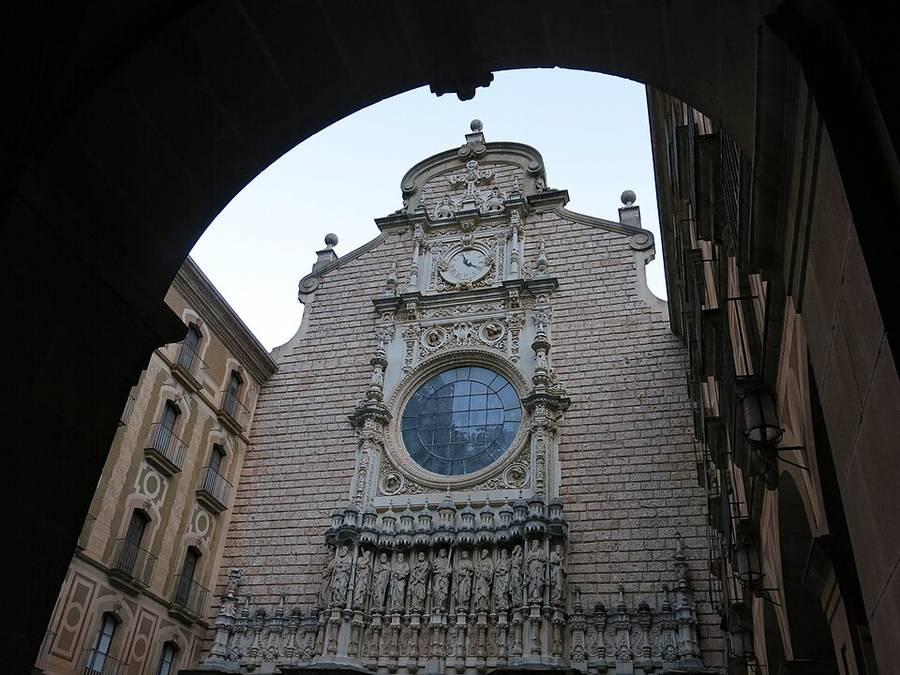
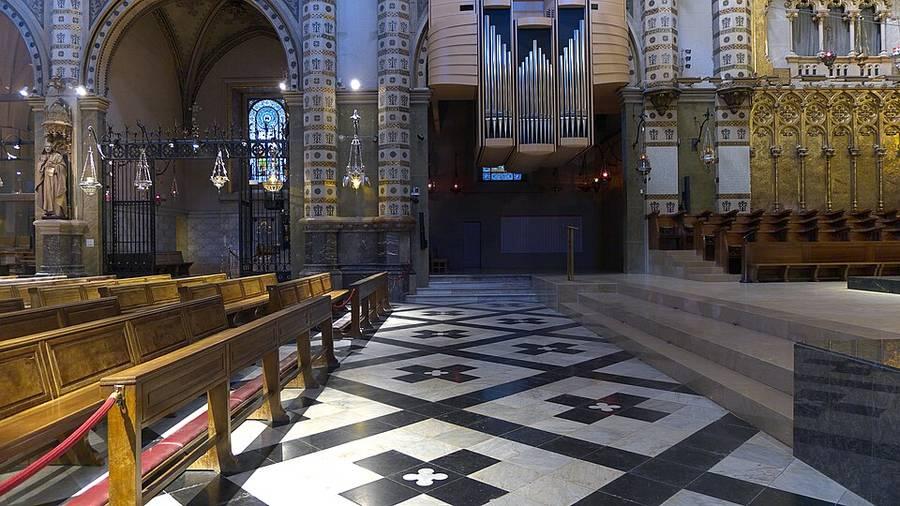
The Benedictine monastery was founded in 1025 under Abbot Oliba. The basilica, begun in 1560 and consecrated in 1592, was ravaged by Napoleon’s troops in 1811–1812 and rebuilt in the 19th century. Above the altar, in the Cambril, sits the Moreneta. She is a 12th-century Romanesque Virgin in polychrome wood, patron of Catalonia since 1881.
Abbot Argerich’s atrium is paved in black and white, in imitation of Michelangelo’s Capitol. The candle path (Ave Maria) runs along the side of the basilica: wax votive offerings and bare rock behind the building.
You glimpse the statue for a few seconds behind glass, after a queue that can exceed an hour at weekends. Go for the first slot or skip it: the basilica stands on its own.
The Montserrat boys’ choir, serving the sanctuary since the 13th century, is one of the oldest in Europe. Since the late 1960s, the midday Salve and Virolai have become the busiest moment of the day. The Virolai, “Rosa d’abril”, is the hymn of Our Lady of Montserrat.
Vespers at 18:45: the basilica is half empty and the light is fading. The polyphonic programme is richer than at midday. It is the best listening of the day if you stay late.
At 13:00, be inside before 12:40, or you will be standing at the back. If you are staying on site or into the evening, choose Vespers.
It grew in 1911 from a biblical collection assembled by the monk Bonaventura Ubach. Today it occupies the former restaurant designed by Puig i Cadafalch beneath the square. Over 1,300 pieces: an Egyptian sarcophagus of the 22nd century BC and Orthodox icons. Old masters (Berruguete, El Greco, Caravaggio, Luca Giordano, Tiepolo) and French Impressionism (Monet, Sisley, Degas, Pissarro). And one of the finest collections of 19th–20th-century Catalan painting (Fortuny, Rusiñol, Casas, Nonell, Picasso, Dalí).
The Nigra Sum room, which gathers depictions of the Moreneta by different artists. It is the best way to understand the icon, without the Cambril queue.
The big names are represented by minor works, so do not come for a masterpiece. Come for Catalan painting, led by Casas and Rusiñol: that is where the collection is truly strong.
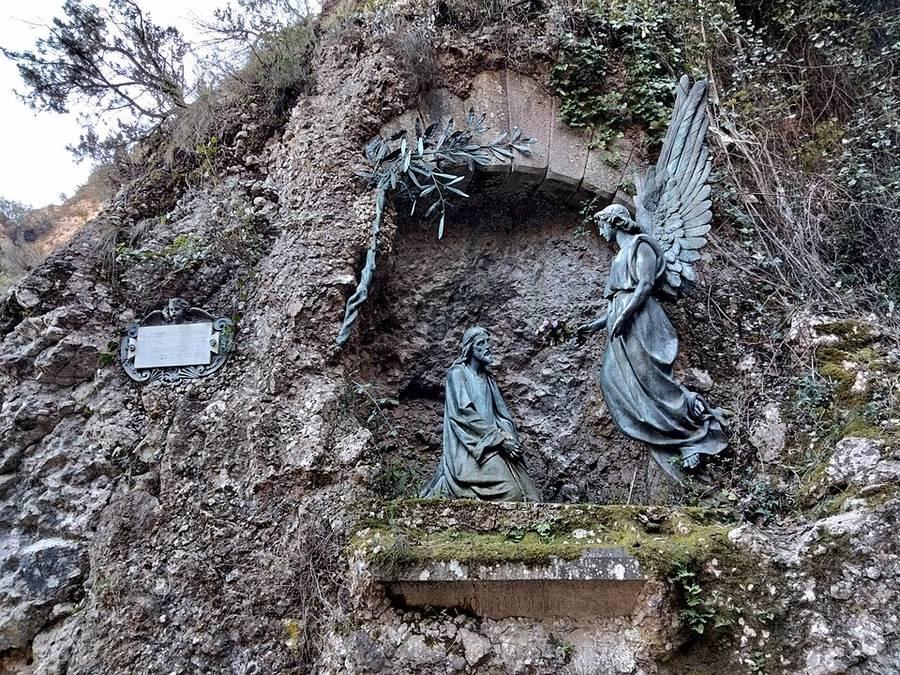
According to legend, shepherds found the image of the Virgin here in 880. The path was cut into the rock between 1691 and 1704, thanks to the Marchioness of Tamarit. From 1896 to 1916 the Monumental Rosary was set along it. Its fifteen sculptural groups form the largest open-air Modernista ensemble in Catalonia. Puig i Cadafalch and Gaudí contributed. The chapel, clinging to the rock, dates from 1696–1705 and was restored in 1997.
The First Glorious Mystery, designed by Gaudí, just after the start of the path: an empty tomb and a risen Christ against the rock. Many walk past without knowing whose work it is.
The funicular closure is a blessing in disguise: the walk makes the visit, not the chapel, which is fairly plain inside.
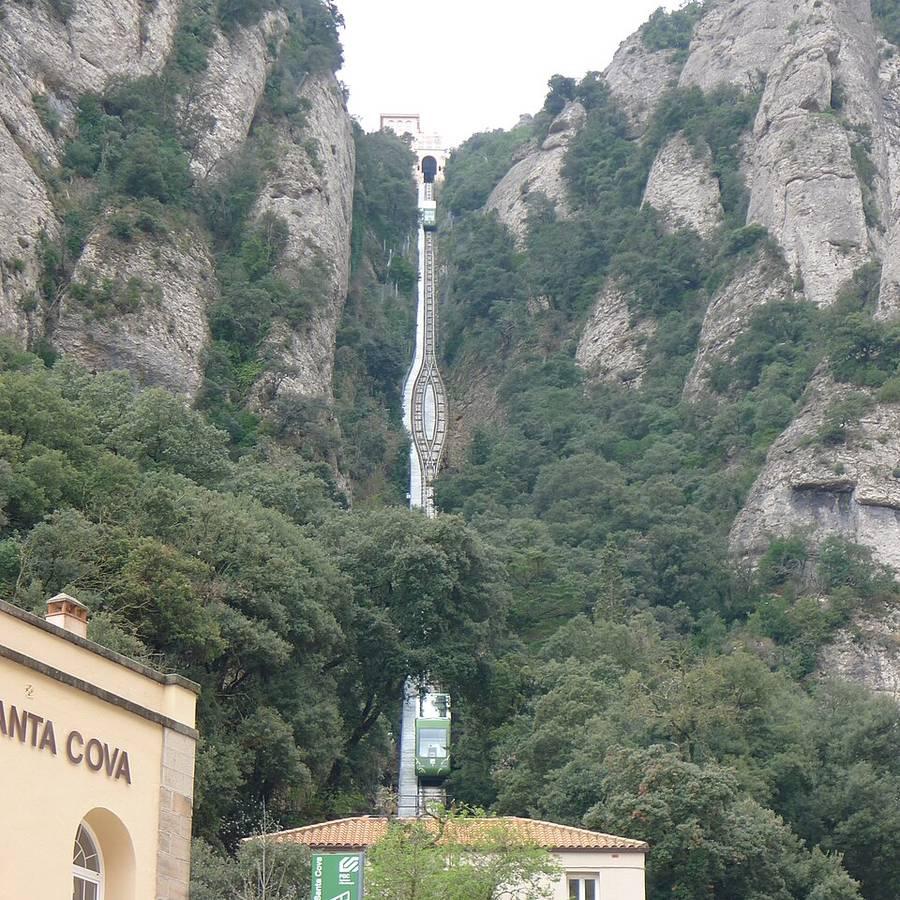
Opened in 1918 to carry pilgrims and walkers up to the upper hermitages. 503 m of track, a maximum gradient of 65 %, and an arrival at about 1,000 m. The upper station houses a viewpoint and the interpretation centre of the Central Catalonia geopark.
The hermitage of Sant Joan, 15 minutes from the upper station. Then the viewpoint over the “Magdalenes” and the “Gorra Frígia”, two of the most photographed pinnacles in the massif.
Buy a single and walk back down. The return ticket is only worth it if you are aiming for Sant Jeroni with fragile knees.
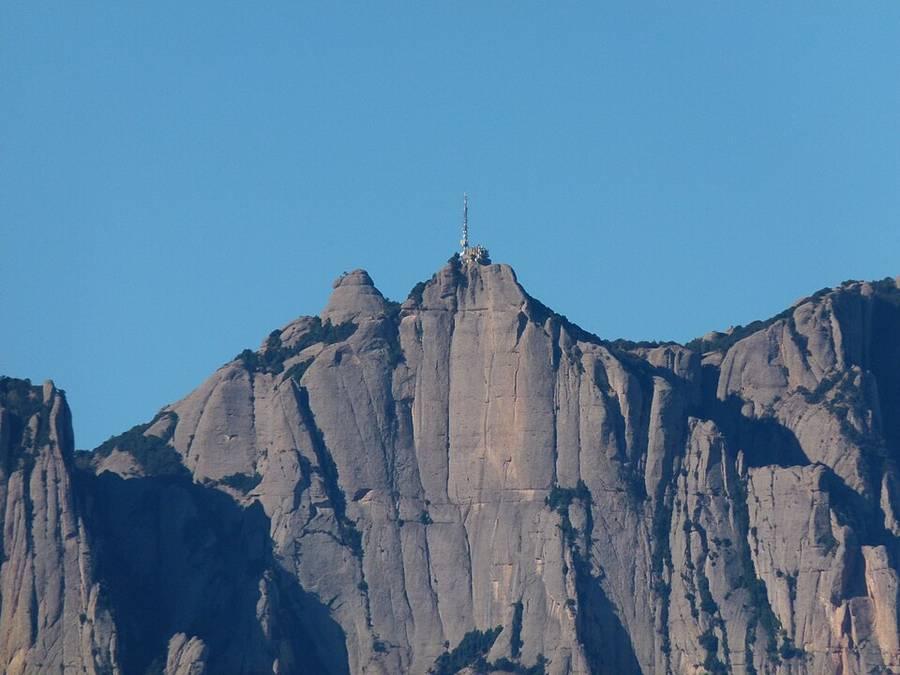
The highest point of the massif, and one of the few Montserrat summits reachable without climbing. A steel compass rose names the surrounding peaks. On a clear day: the Pyrenees to the north, Montseny and Sant Llorenç del Munt to the east, the sea to the south. Santa Cecília lies 600 m below, at your feet.
The descent by the Camí Vell passes the Pla de Santa Anna and the ruins of its hermitage. Then comes the Escala dels Francesos, a narrow passage between two rocks that recalls Napoleon’s troops.
The best ratio of effort to reward on the site. But the summit is small, fenced and crowded at midday. Aim for late afternoon on a weekday, with a warm layer.
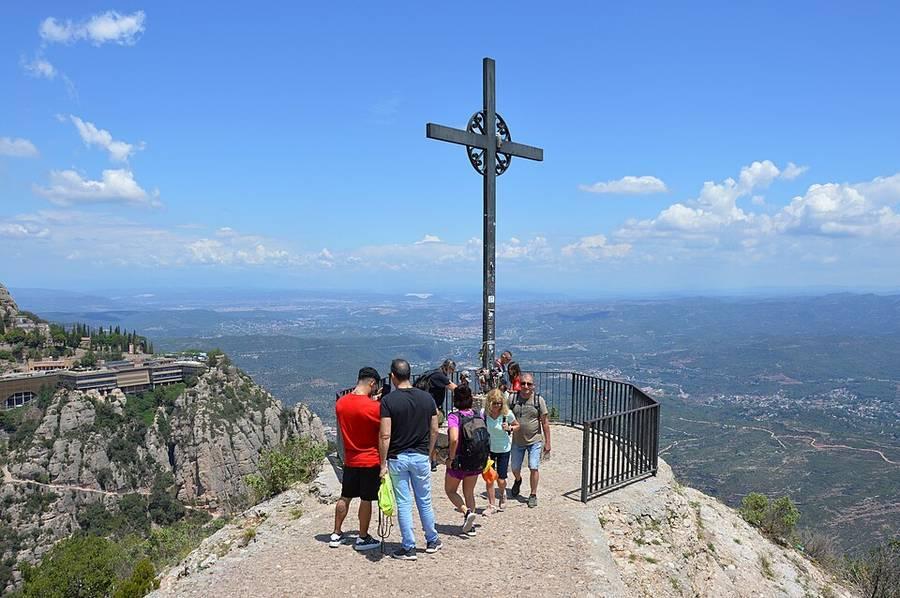
An iron cross planted on a rocky spur, at the end of a short pedestrian road from the monastery. The viewpoint faces the monastery head-on, with the Llobregat valley below.
The chapel of Sant Miquel, on the same path: most pass without stopping. From there, a track joins the upper station of the Sant Joan funicular to make a loop.
This is the only view that shows the monastery in its setting. If you lack time to climb Sant Jeroni, do at least this one.
Less visited for a simple reason: you have to walk, drive or book. That is precisely what makes them interesting.
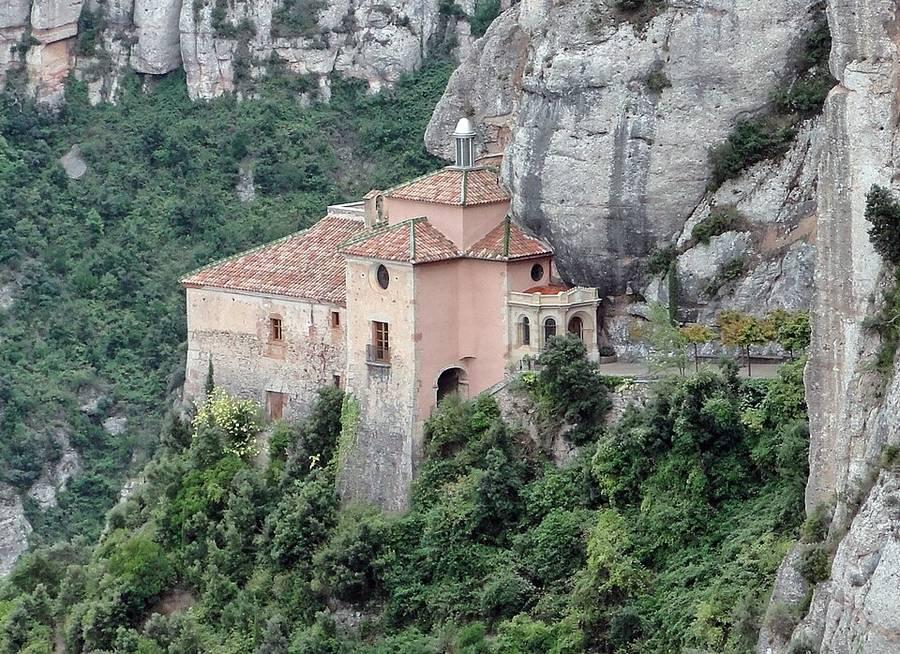
The first monastery on the mountain, recorded from 945, even before Santa Maria. An 11th-century Romanesque church with three Lombard apses. Puig i Cadafalch restored it in the 1920s, then the Diputació de Barcelona in 2013–2015. Since 30 June 2015 the interior has housed the work of Sean Scully. Six large paintings, eight stained-glass windows, three frescoes, a glass retrochoir, three glass crosses and four candelabra.
The interpretation centre at the entrance, which explains the floor stratigraphy revealed by the restoration: you literally walk on a thousand years of layers.
The most singular place in the massif, and almost empty. The clash between Romanesque stone and Scully’s bands of colour divides opinion. Some cry sacrilege, others spend an hour there. Go and decide for yourself.
In the 17th and 18th centuries a dozen hermits lived in perched cells. Some were caves, others small monasteries with a cistern and vegetable plot. Santa Anna, built in the late 15th century at the expense of Joan of Aragon, served as the hermits’ parish. Sant Dimes was built on the ruins of a castle used as a bandits’ refuge; Ignatius of Loyola is said to have made his confession there. Sant Salvador is wedged into a cleft in the rock.
The hermitage of Sant Antoni, a viewpoint over the Cavall Bernat (1,111 m), the most famous monolith among Catalan climbers.
Do not go for the buildings, almost all ruined or closed. Go for the feeling of being alone among the pinnacles an hour from the crowded forecourt. The steps are steep and many.
An almost level walk along the rock wall north of the monastery. It takes its name from the “degotalls”, the drips that seep from the conglomerate. The path is lined with monuments and commemorative plaques donated throughout the 20th century. It opens onto the Apòstols viewpoint.
The late-afternoon light on the rock walls, when the pink of the conglomerate comes out. In the morning the path is in shade and dull.
The best plan B if someone in the group does not want to walk uphill. Alone and unconstrained, choose the Tebaida.
The only cave in the massif open to the public, out of more than a hundred. Occupied from the Early Neolithic to the Bronze Age, it was mined in the Middle Ages for the saltpetre that gives its name. It served as a hiding place during the war against Napoleon. It became a tourist curiosity around 1850; Verdaguer, Rusiñol and Gaudí visited it. The descent goes down to the “Pou del Diable”.
The village of Collbató itself: 13th-century medieval streets, remains of the castle tower, and a local tradition of organ building.
Tours are in Catalan by default: ask for another language when booking. Not essential if you have already seen fine caves; ideal on a rainy day.
The El Bruc flank, about 7 % of the natural park, is the least known part of the massif. It is a labyrinth of monoliths and sheer walls. The col takes its name from the fortified masia of Can Maçana, an old staging post where the roads from Barcelona, Manresa and Igualada met. Exchanged with the monastery, it was fought over during the Carlist Wars.
The path to the Roca Foradada, the pierced rock, and the Agulles area. This is where you understand why the mountain is called “sawn”.
For hikers, not sightseers. Little tourist waymarking, few people, and a sunset over the massif that no one will sell you as a postcard.
On the site itself, choice is thin and quality average: local sources agree on this. The best table is often below, in Monistrol or Collbató. Prices taken from third-party sites at varying dates: phone before you travel.
Convenient, captive, and it shows on the plate.
≈ €35 with wine (third-party source)
Plaça del Monestir · Catalan cooking, table service
In a 16th-century building attached to the hotel, a dining room under a stone vault. Meat and fish; the only proper restaurant on the site.
Ask for a table near the arch. Book at weekends.
€€
Sanctuary · tapas and à la carte, view
Opened in 1976, with a panoramic view of the mountain. A picture menu of classic tapas.
You are paying for the view. Local reviews rate the cooking as ordinary.
Buffet ≈ €18 (recorded 2025)
Opposite the rack railway station · buffet, sandwiches
Coffee, pastries and sandwiches all day; a simple buffet at lunchtime. Few vegetarian options.
Useful for a coffee at 9:00, not for lunch.
€
On the way up to the square · picnic
Farmhouse cheeses, honey, and mel i mató, fresh cheese with honey, the local speciality.
The best choice if you are heading up Sant Jeroni: have lunch on the summit.
15–20 min by car, or at the foot of the rack railway.
€€ · set lunch
C/ Sant Joan 32, Monistrol · Catalan market cooking
Chefs María José Lara and Marcela Orellana, local produce. Canelons, tartares, wines from the region. A few minutes’ walk from the rack railway.
The best nearby address, cited by several sources. The guide’s first choice for dinner after the day.
€€
C/ Sant Pere 17, Monistrol · Mediterranean
Meat and fish cooking, vegetarian options, a warm welcome.
Opening times not verified: phone.
Set menu €13 weekdays / €15 weekends (old prices)
C-55, km 14, Monistrol · family-run, by the river
Unfussy Catalan cooking, lunch only, house wine included in the set menu.
Prices published several years ago: expect more.
For day 2, with the caves or Can Maçana.
€€ · set menu or à la carte
C/ Muntanya 1, Collbató · Catalan cooking
Lunch only. A village address, ideal after the caves.
Closed in the evening: plan it for lunch.
€€
C/ Montserrat s/n, El Bruc · country setting, local produce
In a natural setting, a menu that changes daily. For a long lunch without watching the clock.
Close to the Coll de Can Maçana.
€€€
C/ Dr. Salvador Cortadellas 2, Esparreguera · creative cooking
Chef-driven cooking in a small town most people drive through on the way up to Montserrat.
For a careful dinner on the way back.