
Food and markets · Overview · checked on 04/11/2026
Barcelona

Catalan cuisine

Mar i muntanya, picada and sofregit, calçots in winter and panellets at All Saints: a cuisine of seasons and calendar. It also produced the most widely copied culinary avant-garde in the world.

  • 10dishes
  • 6chefs or sibling teams
  • 5three-star tables
  • 8places

This page presents ten dishes, two of them from elsewhere and adopted by Barcelona. Then come the chefs who took Catalonia from grandmother’s cooking to the laboratory. Choose the month of your visit: the list keeps only what is eaten at that time.

Status as of 04/11/2026

The calçot season begins in late November; the panellet season is ending. Pastry shops withdraw panellets in the days after All Saints. The first calçotades are announced in Valls for the end of the month.

elBulli1846 is closed until 2027. The museum’s season is over; the 2027 calendar will be published from mid-March.

Tonight in Lima, the ceremony for The 50 Best Restaurants 2026. Disfrutar, first in 2024, no longer competes.
4 Nov.
Michelin Guide Spain 2027 gala in Huesca, postponed by a week because of the 29 November elections.
1 Dec.
Starred restaurants and stars in Catalonia in the 2026 guide, including five three-star tables. No other region has as many.
62 · 81
Gran Festa de la Calçotada 2027 in Valls, opening the high season for calçots.
31 Jan.

The keys

The dishes

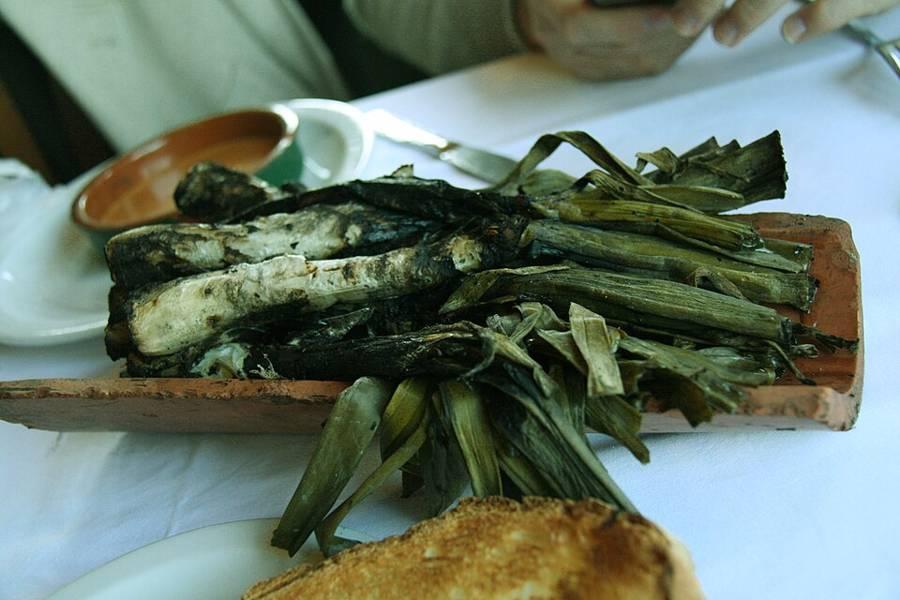
Calçots blackened by the embers, served on a roof tile
Grilled calçots, served on a roof tile to keep them hot.Photo: Tamorlan · CC BY-SA 3.0 · Wikimedia Commons
In season

Calçots amb salsa

grilled onions, almond and ñora sauce

Season
Late November to April; peak from January to March
Origin
Valls (Alt Camp), Tarragona

The calçot is a white onion, replanted and earthed up (calçat) to lengthen its white part. It is grilled over a fierce fire of vine cuttings until the skin turns black. It is then wrapped in newspaper to finish cooking in its own steam.

You hold it by the leaves, pull off the charred skin in one motion, dip it in the sauce and eat it head tilted back. Tradition credits a Valls farmer of the late 19th century, nicknamed Xat de Benaiges, with the invention. It is a local legend, not an established fact.

The calçotada is a group meal outdoors, followed by grilled meats (botifarra, lamb) and red wine from the porró.

The guide’s view

Ask for the bib: it is part of the ritual. Calçots are eaten mostly at weekends in the masies around Valls. In Barcelona a few restaurants serve them in season, dearer and less good than at the source.
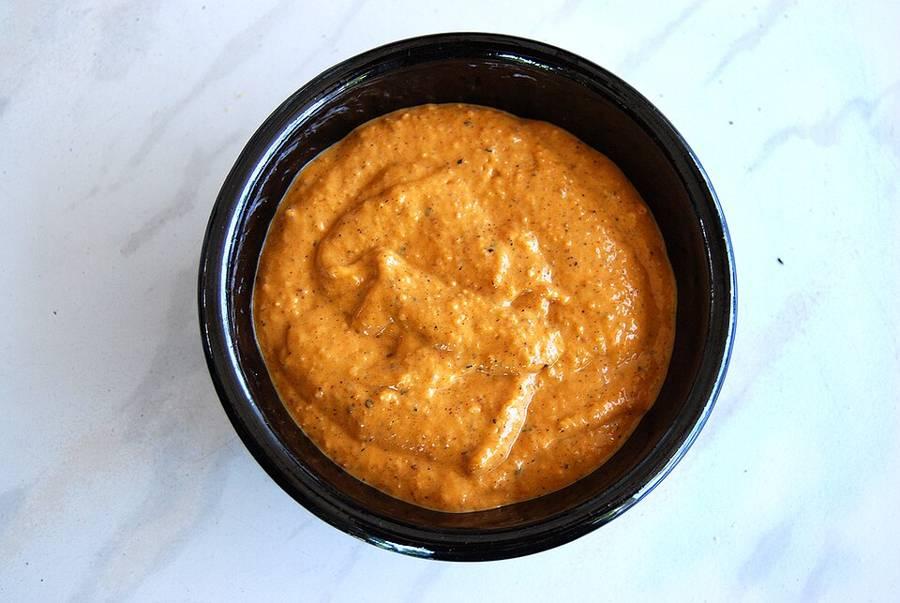
Bowl of orange romesco sauce
Romesco: roasted ñora, tomato and garlic, almonds or hazelnuts, bread, oil, vinegar.Photo: Laia from Reus, Catalonia · CC BY 2.0 · Wikimedia Commons
All year

Salsa romesco

sauce of dried peppers and nuts

Season
All year
Origin
Tarragona and the Camp de Tarragona

Romesco is pounded in a mortar from roasted tomatoes and garlic, toasted hazelnuts or almonds, and fried bread. Olive oil, vinegar and nyora are added; the nyora is a small, sweet dried red pepper. The result is thick, brick-red, more fruity than hot.

In Tarragona, romesco also means a fish stew bound with this sauce. With calçots, people speak rather of salsa de calçots. Every family in Valls claims its own, runnier than restaurant romesco.

The guide’s view

Try it with grilled fish, artichokes or ember-roasted vegetables (escalivada). A romesco of a bright, uniform red often comes from an industrial jar.

All year

Fideuà

noodle paella

Season
All year; mostly at lunchtime
Origin
Gandia (Valencian region), adopted along the whole Catalan coast

Fideuà is cooked like a seaside rice dish, in a wide pan. But short thin noodles (fideus) replace the rice. The reduced fish and shellfish stock is absorbed by the pasta; the best noodles end up standing on end, crisp on top.

Tradition places its birth in Gandia in the early 20th century, on a fishing boat. A cook is said to have swapped rice for pasta there. The story cannot be verified. The dish is Valencian in origin; Barcelona adopted it so fully that many visitors think it Catalan.

It is served with allioli (garlic and oil emulsified, without egg in the strict version). Its Catalan cousins are arròs negre, made with cuttlefish ink, and fideus a la cassola, made with meat.

The guide’s view

A fideuà is ordered for at least two and takes 20 to 30 min. A restaurant that shows it in a photo on a board by the door often serves it reheated.

All year

Tapes, pica-pica et vermut

small plates to share

Season
All year; vermut at midday, especially at weekends
Origin
Spanish custom; the Catalan tradition proper is pica-pica

The word tapas comes from Andalusia and Castile. Tapas bars are everywhere in Barcelona, but the Catalan habit is rather pica-pica. A few plates are set in the middle of the table, before the main course or instead of a meal.

The local landmark is the Sunday lunchtime vermut. It comes with olives, crisps, tinned shellfish, anchovies from L’Escala and pa amb tomàquet (bread rubbed with tomato, oil and salt). Bravas are from Madrid. The Barceloneta bomba, a potato ball stuffed with meat, is Barcelona’s best-known contribution.

The esmorzars de forquilla are the other Catalan ritual: knife-and-fork breakfasts of tripe, snails or botifarra. They are eaten before 11:00, in market bars.

The guide’s view

Don’t order everything at once: two or three plates, then order again. Sangria is served mostly to tourists; at table, Barcelonans drink wine, beer or cava.

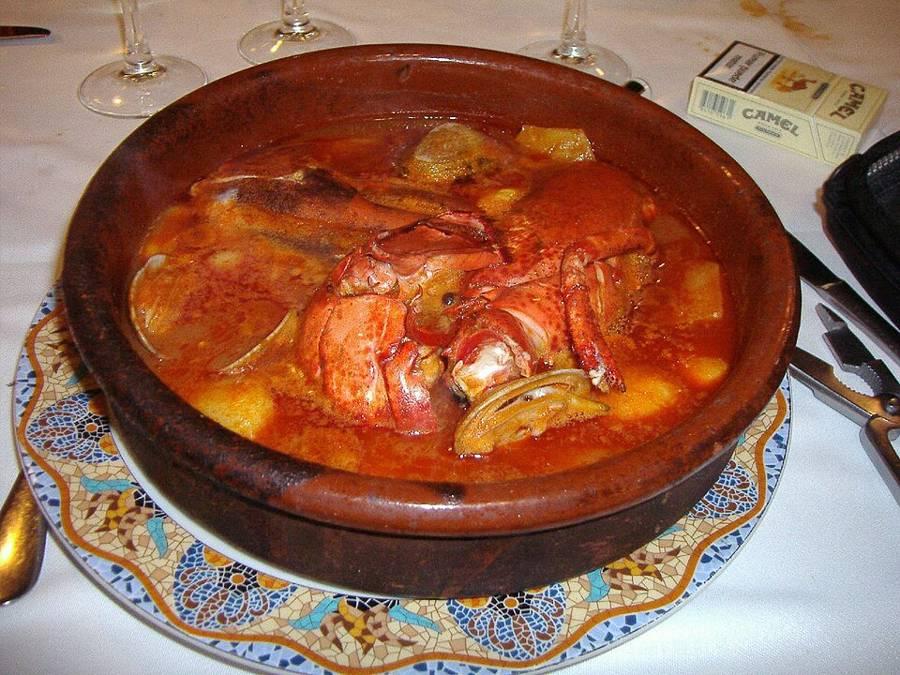
Earthenware dish of fish and shellfish suquet
Fish and shellfish suquet, in an earthenware dish.Photo: Hector Garcia from Barcelona, Catalonia, Spain · CC BY-SA 2.0 · Wikimedia Commons
All year

Suquet de peix

fishermen’s fish stew

Season
All year; depending on the day’s catch
Origin
Catalan coast, from the Costa Brava to the Ebro delta

Suquet is the meal fishermen cooked on board with the fish they could not sell. Scorpionfish, monkfish, conger and gurnard, then potatoes and a little seawater. The name comes from suc, the juice, which the potato thickens.

It is finished with the picada, the signature of Catalan cooking. Garlic, parsley, almonds or hazelnuts and fried bread are pounded in a mortar. They go in at the end of cooking to bind and perfume the stew.

The guide’s view

The best is eaten in the fishing ports (Palamós, Roses, L’Escala) rather than in Barcelona. Ask which fish is in it: the answer tells you whether it was made that day.

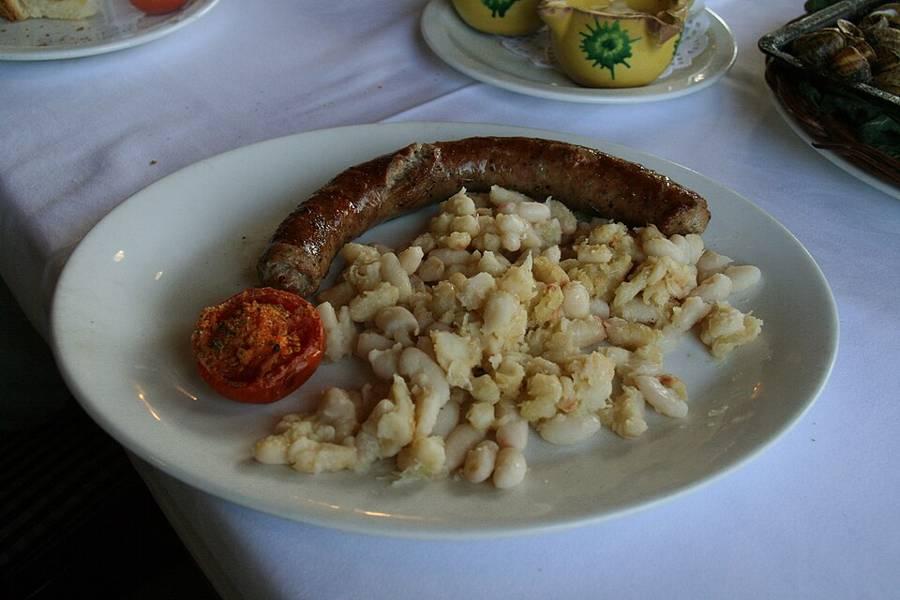
Grilled sausage and sautéed white beans with allioli
Botifarra and sautéed mongetes, with allioli.Photo: Tamorlan · CC BY 3.0 · Wikimedia Commons
All year

Botifarra amb mongetes

grilled sausage and white beans

Season
All year
Origin
All of Catalonia, an everyday dish

Botifarra is the fresh Catalan pork sausage, simply salted and peppered, grilled over embers. It comes with white beans, boiled then sautéed in the cooking fat (mongetes saltades), often with allioli.

The family is large: botifarra negra with blood, botifarra d’ou with egg for Dijous Gras, sweet botifarra dolça from the Empordà. The best beans are mongetes del ganxet, small and fine, from the Vallès and the Maresme.

The guide’s view

This is the quintessential menu del dia dish. It makes a good test of a neighbourhood restaurant, and one of the cheapest meals in the city.

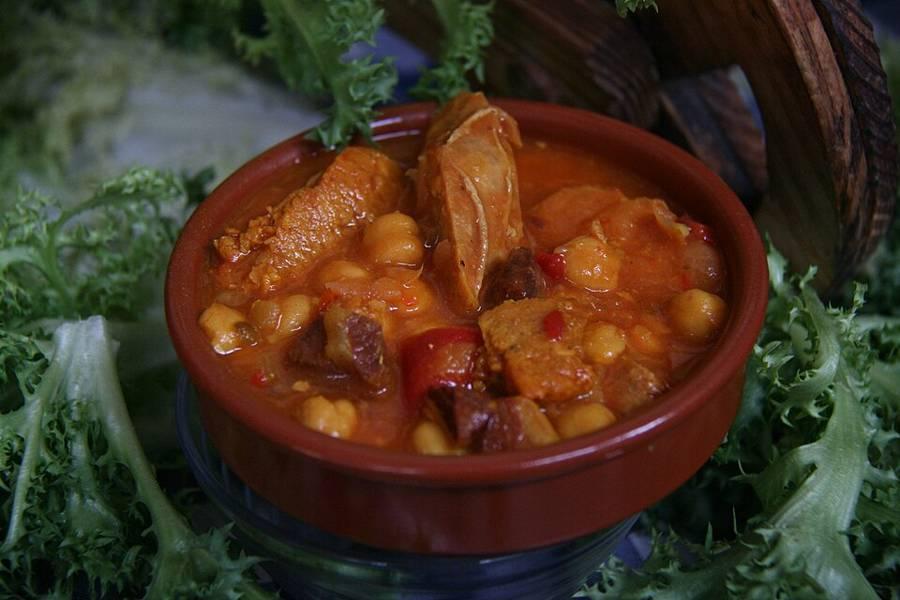
Escudella served in an earthenware dish with meats, chickpeas and botifarra
Escudella barrejada: broth, meats and vegetables served together.Photo: Tamorlan · CC BY 3.0 · Wikimedia Commons
In season

Escudella i carn d’olla

Catalan boiled dinner in two courses

Season
November to March; the dish of 25 December
Origin
All of Catalonia, a winter and Christmas dish

Beef, pork and hen, bones, botifarra blanca and negra simmer for hours in the same pot. Chickpeas, cabbage, potatoes and a large meatball, the pilota, are added.

The broth (the escudella) is served first with pasta, then the meats and vegetables (the carn d’olla). At Christmas the broth holds galets, large shell-shaped pasta stuffed with meat. Served mixed, broth and garnish make escudella barrejada.

The guide’s view

Few restaurants offer it out of season, as it needs a large pot and a whole morning. Look for it on the Thursday or Saturday lunch menu in winter.

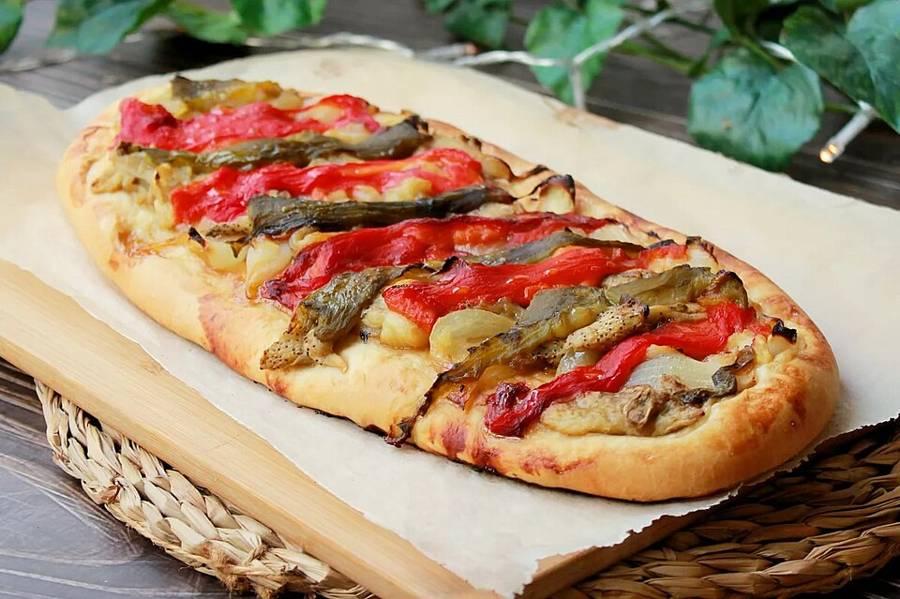
Coca de recapte with grilled peppers and aubergines on a board
Coca de recapte: peppers, aubergines, onions, sometimes sardines.Photo: Ramon Flix Pere · CC BY-SA 4.0 · Wikimedia Commons
All year

Coca

flatbread, savoury or sweet

Season
All year; coca de Sant Joan on 23 June
Origin
All Catalan-speaking lands

Coca is bread dough rolled into a long flatbread and baked in the oven. The best-known savoury version is coca de recapte, typical of Lleida and the interior. It is topped with grilled vegetables, onions, sometimes sardines or botifarra.

The sweet versions mark the calendar. Coca de llardons, with pork crackling and pine nuts, belongs to Dijous Gras. Coca de Sant Joan, with candied fruit, custard and pine nuts, is eaten on the night of 23 June. It is shared with cava while waiting for the bonfires.

The guide’s view

Neighbourhood bakeries sell coca de recapte by the slice, for a quick meal. Coca de Sant Joan is ordered from pastry shops a few days before 23 June.

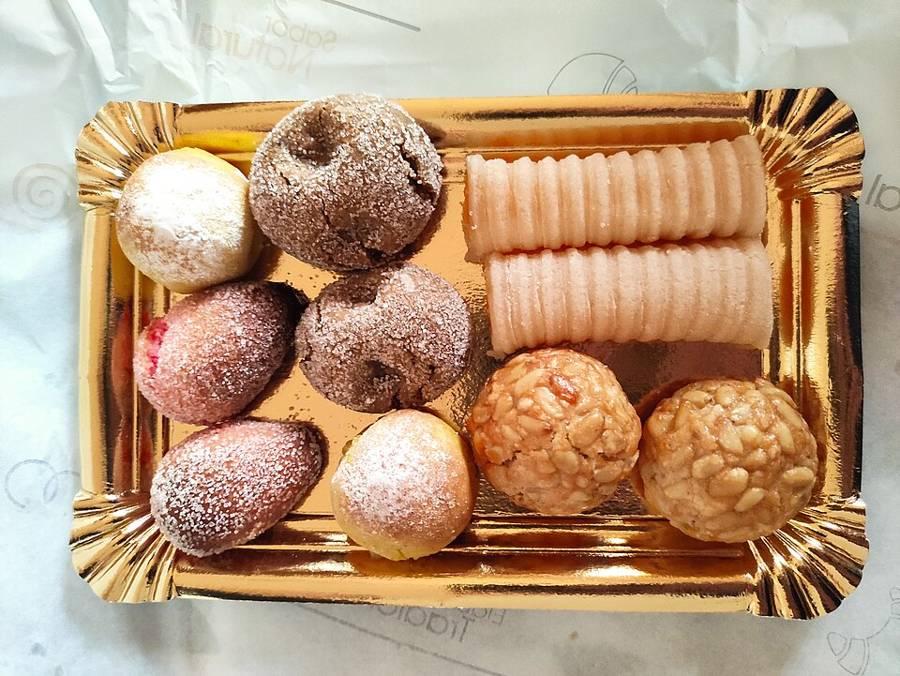
Assortment of panellets: pine nuts, coconut, coffee, almonds
All Saints’ panellets: pine nuts, coconut, coffee, almonds.Photo: Francesc Fort · CC BY-SA 4.0 · Wikimedia Commons
In season

Panellets

little marzipan cakes with pine nuts

Season
Late October to mid-November, around All Saints
Origin
All of Catalonia; the Castanyada festival

The panellet is a ball of marzipan: almond, sugar, and often potato or sweet potato. Rolled in pine nuts, coconut or cocoa, it is then browned in the oven. Panellets are eaten on the eve and the day of All Saints (Tots Sants), with roast chestnuts and sweet potatoes.

The meal is called the Castanyada and ends with a glass of sweet wine, moscatell or vi ranci. The festival is losing ground to Halloween in schools. Pastry shops still make it their biggest week of the year.

The guide’s view

Buy them by weight from a pastry shop, not in a supermarket tray. The pine-nut panellet is the classic; the pine nuts should be whole, tightly packed and golden.

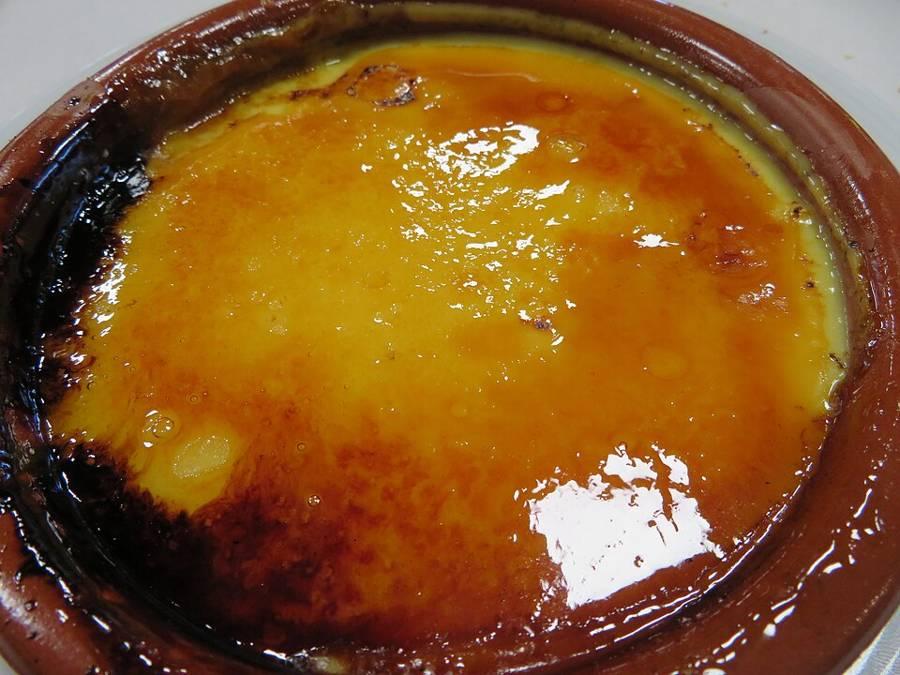
Caramelised crema catalana in an earthenware dish
Crema catalana in an earthenware dish: the sugar crust should crack.Photo: Juan Emilio Prades Bel · CC BY 4.0 · Wikimedia Commons
All year

Crema catalana

stovetop custard, caramelised with an iron

Season
All year; traditionally on 19 March
Origin
All of Catalonia; also called crema de Sant Josep

Milk infused with lemon zest and cinnamon, egg yolks, sugar and a little starch. Crema catalana is cooked in a saucepan, not in the oven. It is chilled, then a layer of sugar is burnt on top with a red-hot iron, the pala, just before serving.

It is eaten on 19 March, the feast of Sant Josep, hence its other name. The comparison with French crème brûlée divides opinion. Both camps claim precedence, and no source settles it.

The guide’s view

The crust should crack and stay warm over a cold custard. A soft custard under sugar that has already softened was burnt too early.

The great chefs and their influence

In a single generation Catalonia went from home cooking, long the work of anonymous women, to the top of the world rankings. Three ideas travelled. Cooking as research, with a workshop and archives; scientific technique in the service of taste, from the siphon to low-temperature cooking. Finally, the idea that a dish can surprise, amuse or tell a story. The rest of the world copied the techniques faster than the attachment to local produce that made them right.

  1. c. 1324
    Llibre de Sent Soví, one of the oldest cookbooks in Europe, written in Catalan.
  2. 1520
    Mestre Robert’s Llibre del Coch, printed in Barcelona, translated into Castilian and reprinted throughout the 16th century.
  3. 1840
    Foundation stone of the Boqueria, the city’s first municipal market.
  4. 1961
    Josep Mercader opens the Motel Empordà in Figueres.
  5. 1986 – 1988
    El Celler de Can Roca opens in Girona, followed by Carme Ruscalleda’s Sant Pau.
  6. 2002
    elBulli is ranked the best restaurant in the world for the first time.
  7. 2011
    elBulli closes; Santi Santamaria dies the same year.
  8. 2013 · 2015
    El Celler de Can Roca tops the world ranking.
  9. 2018
    Carme Ruscalleda closes Sant Pau.
  10. 2023
    The elBulli1846 museum opens at Cala Montjoi.
  11. 2024
    Disfrutar, founded by three elBulli alumni, tops the world ranking.
1926 – 1979

Josep Mercader

Motel Empordà, Figueres

In 1961 he opened a hotel-restaurant on the road to France, applying French technique to the produce of the Empordà. He lightened peasant dishes without betraying them. The American critic Colman Andrews called the Motel the cradle of modern Catalan cuisine.

Influence. He proved that a regional cuisine could become a chef’s cuisine. His centenary is celebrated in 2026.

1957 – 2011

Santi Santamaria

Can Fabes, Sant Celoni

Self-taught, he turned a family farmhouse in the Montseny into a table of produce, season and terroir. It was the first in Catalonia with three stars. Can Fabes closed after his death.

Influence. He was the critical voice of the avant-garde. His public clash with Ferran Adrià in 2008, over additives and cooking as spectacle, still divides the profession.

born 1962 and 1969

Ferran and Albert Adrià

elBulli, Cala Montjoi (Roses)

Ferran turned a restaurant in a cove into a laboratory kitchen: siphon foams, spherification, hot gels, deconstructed dishes. The restaurant opened six months a year; in winter the team created the next menu in a Barcelona workshop. His brother Albert ran the pastry section before opening his own places, including Enigma, two stars in 2026.

Influence. elBulli was five times first in The World’s 50 Best (2002, 2006 to 2009) and closed in 2011. Its former cooks, the “bullinianos”, have spread across the world.

born 1952

Carme Ruscalleda

Sant Pau, Sant Pol de Mar

The daughter of farmers and shopkeepers in the Maresme, she opened Sant Pau in 1988 in the former family grocery. Her cooking follows the kitchen garden and the calendar, with themed menus renewed each season.

Influence. A third star for Sant Pau in 2005, then two in Tokyo and two at Moments in Barcelona. Seven stars at once: a record for a woman. She closed Sant Pau in October 2018.

born 1964, 1966 and 1978

Joan, Josep and Jordi Roca

El Celler de Can Roca, Girona

Three brothers raised in their parents’ restaurant, in a working-class district of Girona. Joan cooks, Josep runs the cellar, Jordi the desserts. They blend grandmother’s recipes, sous-vide cooking at low temperature and the distillation of aromas.

Influence. Three stars since 2009, first in the 50 Best ranking in 2013 and 2015. The Celler showed that one could innovate without leaving family memory behind.

opened 2014

Oriol Castro, Eduard Xatruch, Mateu Casañas

Disfrutar, Barcelona

The three former head chefs of elBulli opened Disfrutar in December 2014, next to the Mercat del Ninot. They extend Adrià’s technique with humour: dishes that smoke, hide or are eaten by hand.

Influence. Three Michelin stars, first in the 50 Best ranking in 2024. Now ranked hors concours (“Best of the Best”), it can no longer compete.

Cooks’ debate

In 2008 Santi Santamaria publicly accused avant-garde cooking of overusing additives and putting spectacle before produce. Ferran Adrià and much of the profession replied that technique serves taste. The quarrel was never settled. It still runs through Catalan tables, between produce-led and creative cooking.

The five three-star tables

RestaurantCityChef
ABaCBarcelonaJordi Cruz
Cocina Hermanos TorresBarcelonaSergio and Javier Torres
DisfrutarBarcelonaCastro, Xatruch, Casañas
LasarteBarcelonaMartín Berasategui (Basque chef)
El Celler de Can RocaGironaJoan, Josep and Jordi Roca

Michelin Guide Spain 2026. The 2027 selection will be announced on 1 December 2026. Book directly on each restaurant’s website, often several months ahead.

Where to see it

Four markets in Barcelona, one restaurant, then three places outside the city. Coordinates are approximate. No ordinary restaurant is recommended here: neighbourhood addresses change too fast to be checked once a year.

Must-seeMarket

Mercat de la Boqueria

Address
La Rambla, opposite the Liceu
Practical
Mon–Sat 8:00–20:30; closed Sunday. Phased renovation works since summer 2026; the market stays open throughout.

The first municipal market (1840) and the most visited. Go before 10:00, when Barcelonans do their shopping, and for the counter bars rather than the fruit juices.

OpenStreetMapGoogle Maps41.38180, 2.17160
Must-seeMarket

Mercat de Santa Caterina

Address
Avinguda de Francesc Cambó, 16
Practical
To be checked: mornings Monday to Saturday; Tuesdays, Thursdays and Fridays until 20:30. Sources disagree on closing time on other days (14:30 or 15:30).

The everyday market, beneath the undulating ceramic roof by Enric Miralles and Benedetta Tagliabue (2005). Smaller crowds than at the Boqueria, the same produce.

In this guide : El Born on foot →

OpenStreetMapGoogle Maps41.38620, 2.17850
Must-seeMarket

Mercat de Sant Antoni

Address
Carrer del Comte d’Urgell, 1
Practical
Mon–Sat 8:00–20:30. Second-hand book market on Sunday mornings.

A large cross-shaped hall renovated in 2018, at the heart of a district of vermouth bars. The right starting point for a Catalan-style Sunday lunch.

OpenStreetMapGoogle Maps41.37860, 2.16170
Must-seeMarket

Mercat de la Concepció

Address
Carrer d’Aragó, 311 (metro Girona)
Practical
Mon and Sat 8:00–15:00; Tue–Fri 8:00–20:00; closed Sunday. Hours from 1 September to 31 July; August to be checked. The outdoor florists are open 24 hours a day, except in August.

The bourgeois market of the Dreta de l’Eixample, opened in 1888 to plans by Antoni Rovira i Trias, architect of Sant Antoni. Renovated in 1998, it gained its glass façades. Locals do their shopping here; its florists, open day and night, are known across the city.

In this guide : Eixample on foot →

OpenStreetMapGoogle Maps41.39510, 2.16830
Must-see3 stars

Disfrutar

Address
Carrer de Villarroel, 163
Practical
Lunch and dinner Monday to Friday; book online on the restaurant’s website, several months ahead.

The most direct descendant of elBulli, on an ordinary street in the Eixample. The Mercat del Ninot next door shows where the produce comes from.

OpenStreetMapGoogle Maps41.38870, 2.15310
UnusualMuseum

elBulli1846

Address
Cala Montjoi, Roses (Girona), 7.5 km from the centre of Roses
Practical
2026 season over: closed until the 2027 season, calendar announced from mid-March. Admission €27.50, 2 hr 30 visit. No restaurant.

The museum in the former elBulli, opened in June 2023. You see the kitchen, the dining room and the restaurant’s history, not Adrià’s cooking on the plate.

OpenStreetMapGoogle Maps42.25310, 3.22610
UnusualFestival

Valls, capital of the calçot

Address
Valls (Alt Camp), 1 hr 15 from Barcelona by car
Practical
Gran Festa de la Calçotada on Sunday 31 January 2027: eating, sauce and growers’ contests, public tasting.

The birthplace of the calçot. Outside the festival, the masies around the town serve full calçotades at weekends from December to April, by reservation.

OpenStreetMapGoogle Maps41.28610, 1.24970
UnusualHistoric table

Motel Empordà

Address
Avinguda de Salvador Dalí, 170, Figueres
Practical
Hotel and restaurant; hours and booking on the establishment’s website.

Josep Mercader’s house, run since 1979 by his son-in-law Jaume Subirós and his family. The Empordà cooking that Mercader codified is still served here.

OpenStreetMapGoogle Maps42.27560, 2.96400

Before you go